
A borrower gets pre-approved by their agent’s “preferred” lender, then opens Google at the kitchen table to double-check rates. They tap your site. It hangs for four seconds on a spinning logo while a page builder loads its scripts. They hit back and tap the next result. You never knew they existed — and no rate, no testimonial, and no calculator on your site got a chance to matter, because the page never finished loading.
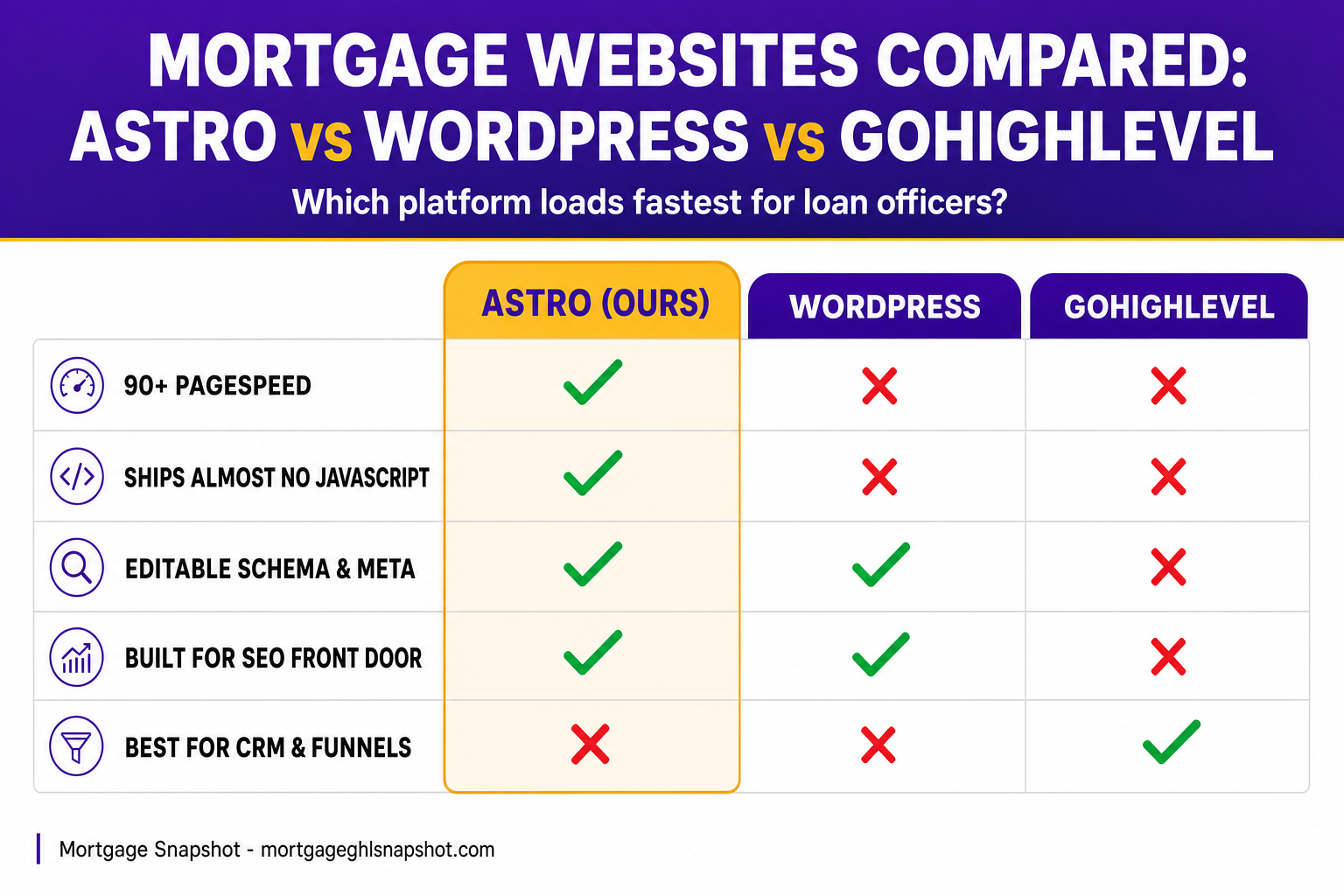
For a mortgage broker’s marketing site, the fastest platform is a statically pre-rendered one like Astro, which ships almost no JavaScript by default and can reliably hit a 90+ PageSpeed score — while typical WordPress and GoHighLevel-built sites carry page-builder and plugin overhead that drags load times into the range where borrowers bounce. That speed gap is not cosmetic. Google’s own research found that 53% of mobile site visits are abandoned if a page takes longer than three seconds to load (Think with Google, 2016). For an originator paying for ads, SEO, and referrals to drive traffic, a slow site quietly throws away half of it.
This is the head-to-head comparison — Astro vs WordPress vs GoHighLevel — built for loan officers, mortgage brokers, and the GHL agencies that serve them. We’ll cover how each platform actually builds a page, what that does to Core Web Vitals and conversion, and the setup that lets you have a blazing-fast front door and a full GoHighLevel CRM behind it.
The short answer: which website platform is fastest for mortgage brokers?
Astro wins on raw front-end speed. It is a static-site framework that pre-renders your pages to plain HTML at build time and, by default, ships no client-side JavaScript — interactivity is added only where you need it, as small “islands.” The result is a page that paints almost instantly and passes Core Web Vitals with room to spare.
WordPress can be fast, but it fights its own architecture. It renders pages with PHP on every request and leans on a theme plus a stack of plugins — often including a visual page builder (Elementor, Divi, Beaver Builder). Each plugin adds CSS and JavaScript. A disciplined WordPress build with caching and a light theme performs well; a typical broker’s WordPress site, loaded with a builder and a dozen plugins, usually does not.
GoHighLevel is a phenomenal CRM and funnel engine, but its websites are page-builder pages. They’re generated by a drag-and-drop editor optimized for speed of building, not speed of loading. You get convenience and tight CRM integration; you give up fine-grained control over the markup, the scripts, and the Core Web Vitals. For a landing page inside a paid funnel that’s often fine. For the SEO-driven marketing site that Google ranks and borrowers judge you by, the ceiling is lower.
So the honest ranking for a marketing/SEO website is: Astro (fastest) → a well-tuned WordPress → a GoHighLevel-built site. But “fastest platform” and “right platform for everything” aren’t the same question — which is why the best answer is a combination we’ll get to below.
Why website speed decides how many borrowers you capture
Speed isn’t a developer’s pet metric — it’s the first filter every borrower runs, usually without realizing it. Home buyers overwhelmingly start online: in the National Association of Realtors’ 2024 study, 100% of buyers used the internet in their home search and 43% said looking online was their very first step (NAR, 2024). And they’re doing it on phones — mobile is roughly 54% of U.S. web traffic as of 2025 (Statcounter, 2025), where slow load times hurt most.
Here’s what the research says happens as your page gets slower:
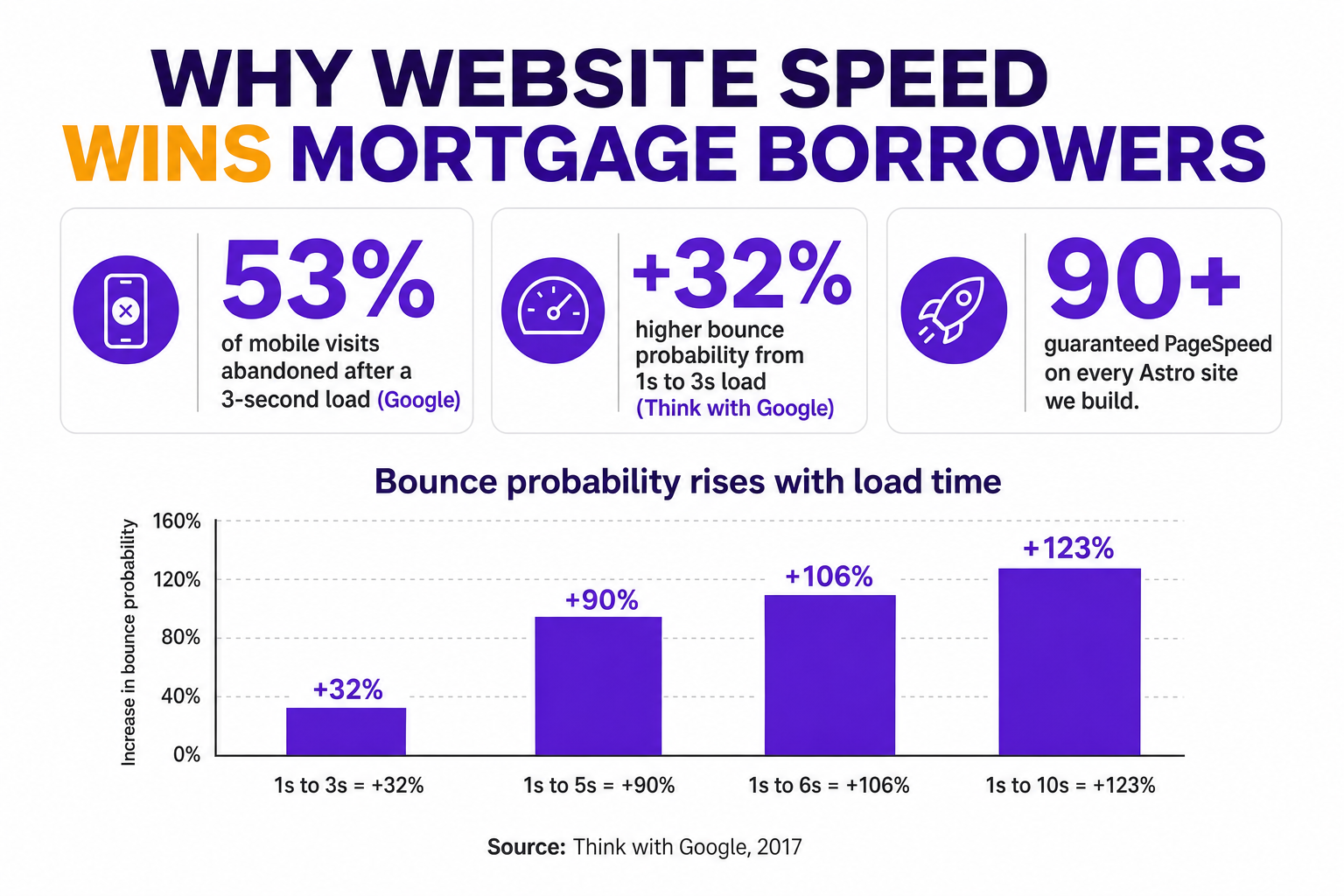
Those bounces aren’t neutral — they’re borrowers you paid to attract. And the flip side is just as measurable. Portent’s analysis of site-speed data found that website conversion rates drop by an average of 4.42% with each additional second of load time between 0 and 5 seconds, with the highest conversion rates landing in the 0–4 second window (Portent, 2022).
Even tiny improvements pay. Deloitte’s Milliseconds Make Millions study, which analyzed more than 30 million user sessions, found that a 0.1-second improvement in mobile site speed increased retail conversions by 8.4% and average order value by 9.2%, with double-digit lifts in travel and comparable gains in lead generation (Deloitte, 2020).
Put plainly: your website speed sets the size of the funnel before your copy, your rates, or your mortgage calculators get a vote. A fast site is the cheapest conversion-rate optimization you’ll ever buy, because it lifts every other channel at once — the same borrower who bounces off a slow page from a Google ad would have converted off a fast one.
How the three platforms actually build a page
The speed differences aren’t luck or a hosting setting — they come straight from how each platform turns a request into a page. Understanding the mechanism is what makes the comparison make sense.
Astro — pre-rendered static HTML, near-zero JavaScript
Astro builds your entire site into static HTML files ahead of time. When a borrower visits, the server (or, in our case, Cloudflare’s global edge network) hands them a finished page — no database query, no server-side rendering per request, no framework booting up in their browser. Astro’s core idea is “zero JavaScript by default”: interactive pieces like a chat widget or a calculator are shipped as isolated “islands” that hydrate independently, so the rest of the page stays feather-light. Less JavaScript to download, parse, and execute is the single biggest lever on mobile speed — and it’s the default here, not an optimization you bolt on later.
WordPress — PHP rendering plus a theme and plugin stack
WordPress generates each page with PHP, usually pulling content from a MySQL database on request, then layering on a theme and however many plugins you’ve installed. This is enormously flexible — it’s why WordPress powers over 40% of all websites (W3Techs, 2025). But flexibility has a weight cost. Each plugin and page builder tends to enqueue its own CSS and JavaScript on every page. It’s a big reason the median mobile page now ships ~570 KB of JavaScript — around 44% of it unused (HTTP Archive, 2024). WordPress can be fast with a lightweight theme, aggressive caching, and plugin discipline; most broker sites aren’t built that way.
GoHighLevel — a drag-and-drop page builder
GoHighLevel’s website and funnel builder is designed so a non-technical operator can assemble pages by dragging blocks around — and it wires directly into the GHL CRM, calendars, and workflows, which is exactly what you want for a funnel landing page. The trade-off is that you’re rendering builder-generated markup and its runtime, with limited control over the underlying HTML, the script load order, or the finer Core Web Vitals details. It’s optimized for building fast, not for loading fast, and it’s not designed to be your schema-rich, location-page-heavy SEO site.
Astro vs WordPress vs GoHighLevel: the head-to-head
Here’s how the three stack up on what actually matters for a mortgage marketing site — speed, control, SEO/AEO, and cost. This is about the marketing website; GoHighLevel’s CRM and automation are evaluated on their own merits in the next section.
| What matters for a mortgage site | Astro (our build) | WordPress | GoHighLevel site |
|---|---|---|---|
| How a page is built | Pre-rendered static HTML, JS-by-island | PHP per request + theme + plugins | Drag-and-drop page builder |
| JavaScript weight | Minimal (zero JS by default) | Often heavy (plugins + builder) | Builder runtime + scripts |
| 90+ PageSpeed realistic? | ✅ Yes, by design | ⚠️ Only with tuning & discipline | ⚠️ Limited control |
| Editable meta, per-page schema | ✅ Full code-level control | ✅ Via SEO plugins | ⚠️ Templated, constrained |
Manual llms.txt / AEO & GEO files |
✅ Built in, auto-generated | ⚠️ Plugin or manual | ⚠️ Manual / not supported |
| Custom code & integrations | ✅ Unlimited (real codebase) | ✅ Extensive (plugins) | ⚠️ Platform features only |
| Security & maintenance surface | ✅ Static, no DB to exploit | ⚠️ Plugins/DB need updates | ✅ Fully managed |
| Location / SEO landing pages | ✅ Scales to dozens cleanly | ✅ Possible, gets heavy | ⚠️ Manual, limited |
| Best job for a mortgage firm | Fast marketing & SEO front door | Content-heavy blog platform | CRM, funnels & automation backend |
| Typical cost (our done-for-you) | $497 once + $97/mo managed | Hosting + plugins + dev time | Included in GHL plan |
The pattern is clear: Astro is purpose-built for the front door — the fast, crawlable, schema-rich marketing site that ranks in Google and converts the borrower who lands on it. WordPress is a capable general-purpose platform that rewards technical discipline. GoHighLevel is where the backend lives — the CRM, the pipelines, the speed-to-lead automation that answers a new lead in seconds. Picking the “best” one only makes sense once you name the job.
Core Web Vitals and the 2026 thresholds Google grades you on
Speed isn’t just felt by borrowers — it’s measured by Google and folded into rankings. Core Web Vitals are part of Google’s page-experience signals used by its ranking systems (Google Search Central). There are three, and to be rated “good” a page must clear each at the 75th percentile of real-user loads (web.dev, 2024):
- Largest Contentful Paint (LCP) ≤ 2.5 seconds — how fast the main content renders. This is where static, pre-rendered HTML crushes per-request rendering.
- Interaction to Next Paint (INP) ≤ 200 milliseconds — responsiveness to taps and clicks. INP replaced First Input Delay as a Core Web Vital in March 2024, and heavy JavaScript is its worst enemy. Less script (Astro’s default) means better INP.
- Cumulative Layout Shift (CLS) ≤ 0.1 — visual stability, so a “Get Pre-Qualified” button doesn’t jump as the page loads and cause a mis-tap.
The through-line: every one of these vitals gets harder to pass as you add JavaScript, render-blocking CSS, and unpredictable third-party scripts — the exact things a plugin stack or a drag-and-drop builder tends to pile on. A platform that ships almost nothing to the browser starts inside the “good” zone; a platform that ships ~570 KB of mostly-unused JavaScript starts behind and has to claw its way back. That’s why we can guarantee a 90+ PageSpeed on an Astro build and no honest agency can guarantee it on a plugin-heavy WordPress or a GHL site.
“But I need a CRM and calculators” — you can have both
Here’s the objection every originator raises, and it’s a fair one: “My leads, pipelines, calendars, and mortgage calculators all live in GoHighLevel. I can’t just rip that out for a fast website.”
You shouldn’t — and you don’t have to. The strongest setup isn’t Astro instead of GoHighLevel. It’s a fast Astro marketing site sitting in front of your GHL backend. The website is the speed-optimized front door that ranks and converts; GoHighLevel is the engine room that captures the lead and runs the follow-up. They connect cleanly:
- Forms and calculators on the Astro site post straight into your GHL CRM, so every borrower lands in your pipeline and triggers your workflows — including instant speed-to-lead follow-up.
- Calendars and chat widgets embed as Astro islands, so booking and the AI chat widget work exactly as they do today — without loading GHL’s full site runtime on every page.
- Your automation, pipelines, and rate-drop alerts stay 100% in GoHighLevel, where they belong.
You keep every dollar of value in your GHL investment and stop paying the speed tax on your public, Google-facing pages. That’s the architecture behind our prebuilt mortgage website: Astro speed on the outside, GoHighLevel power on the inside.
How to get a 90+ PageSpeed mortgage site without becoming a developer
You don’t need to learn Astro, wrestle a WordPress plugin stack, or fight a page builder’s Core Web Vitals. That’s exactly what our Get a Website service is for — a done-for-you Astro mortgage site, built and managed, so you get the speed without the engineering.
What’s included:
- A blazing-fast Astro build with a guaranteed 90+ PageSpeed — up to 60 pages, including per-city and per-loan-program location pages that help you win local search.
- SEO, AEO, and GEO built in — clean titles and meta, per-page schema, and auto-generated
llms.txtso AI answer engines (Google AI Overviews, Perplexity, ChatGPT) can read and cite you. - CRM wiring to your GoHighLevel account — forms, calculators, calendar, and an AI chat widget all feeding your pipeline.
- Managed hosting, domain, and SSL on Cloudflare’s edge — plus ongoing maintenance and support tickets each month.
The cost is $497 one-time + $97/month (you pay only the monthly up front; the one-time fee is charged after the site is live and you’re happy), with an optional auto-blogging add-on that publishes two niche posts a week. Compare that to the ongoing developer time a fast custom WordPress build demands — or the conversions a slow GHL site quietly costs you every month.
Frequently asked questions
Astro vs WordPress vs GoHighLevel — quick answers
Is Astro actually faster than WordPress for a mortgage website?
Yes, for the same content, because of how each renders. Astro pre-builds static HTML and ships almost no JavaScript by default, so pages paint fast and pass Core Web Vitals easily. WordPress renders with PHP on each request and usually loads a theme plus plugins that add scripts — the median mobile page now ships around 570 KB of JavaScript, about 44% of it unused (HTTP Archive, 2024). A carefully tuned WordPress site can be fast; a typical broker's plugin-heavy site is not.
Should I build my mortgage website inside GoHighLevel?
GoHighLevel is excellent for funnel landing pages, CRM, calendars, and automation — keep all of that. But its drag-and-drop builder gives you limited control over markup and Core Web Vitals, so it's not the best tool for your SEO-driven marketing site. The strongest setup is a fast Astro marketing site in front of your GHL backend: the website ranks and converts, and forms and calculators still post into GoHighLevel.
What Core Web Vitals scores do I need to pass Google?
To be rated 'good,' a page needs Largest Contentful Paint of 2.5 seconds or less, Interaction to Next Paint of 200 milliseconds or less, and Cumulative Layout Shift of 0.1 or less, measured at the 75th percentile of real loads (web.dev, 2024). INP replaced First Input Delay in March 2024. Core Web Vitals are part of Google's page-experience ranking signals.
How much does a fast Astro mortgage website cost?
Our done-for-you Astro build is $497 one-time plus $97/month, which covers managed Cloudflare hosting, your domain, SSL, and maintenance. You pay only the monthly invoice up front; the one-time build fee is charged after the site is live and you're satisfied. An optional auto-blogging add-on publishes two posts a week. See Get a Website for details.
Will a faster website really get me more borrowers?
It widens the top of your funnel. Google found 53% of mobile visits are abandoned after a 3-second load (Google, 2016), and Portent measured conversion rates dropping ~4.42% for each additional second of load time (Portent, 2022). Speed lifts every channel at once — ads, SEO, and referrals all convert better against a fast page.
Can I keep my existing GoHighLevel calculators and calendar on a new site?
Yes. Calculators, calendar booking, and the AI chat widget embed on the Astro site as lightweight islands and continue posting into your GoHighLevel account, so your pipelines, workflows, and rate-drop alerts run exactly as they do now. You get Astro speed on the public pages and keep the full GHL backend. You can also hire a GHL VA to manage it.
About the author
Emilio Duarte is a GHL Automation Lead for the mortgage niche, based in Tampa, FL. He builds GoHighLevel snapshots and the fast, lead-capturing websites that feed them — focused on borrower capture, page speed, and turning traffic into booked appointments without anyone touching a keyboard. Emilio is a fictional editorial persona for Mortgage Snapshot; nothing here is individualized financial, legal, or compliance advice. Calculator outputs are estimates only, and we are not a lender.
Related reading
- Local SEO for mortgage loan officers: the 2026 Google Business Profile playbook — a fast site is the front door your rankings send borrowers to.
- Mortgage speed-to-lead: why the first 5 minutes decide the deal — the GHL backend that answers the leads your fast site captures.
- Why every mortgage broker needs FHA, VA, USDA, and refi calculators — the highest-converting pages to put on your fast website.
- Missed-call text-back for loan officers — the instant follow-up that pairs with your site’s forms.
- How to improve your mortgage lead conversion rate — where site speed fits in the full conversion picture.