
You booked the Total Expert demo because a bigger shop down the road swears by it. Forty minutes later the rep still hasn’t said a number, he’s asked twice how many loan officers you have, and the “custom proposal” lands with an implementation line item bigger than a month of any tool you shortlisted. You’re a solo LO, or you run a shop with four others. You don’t need a bank-grade platform. You need to stop losing borrowers to slow follow-up without signing an enterprise contract.
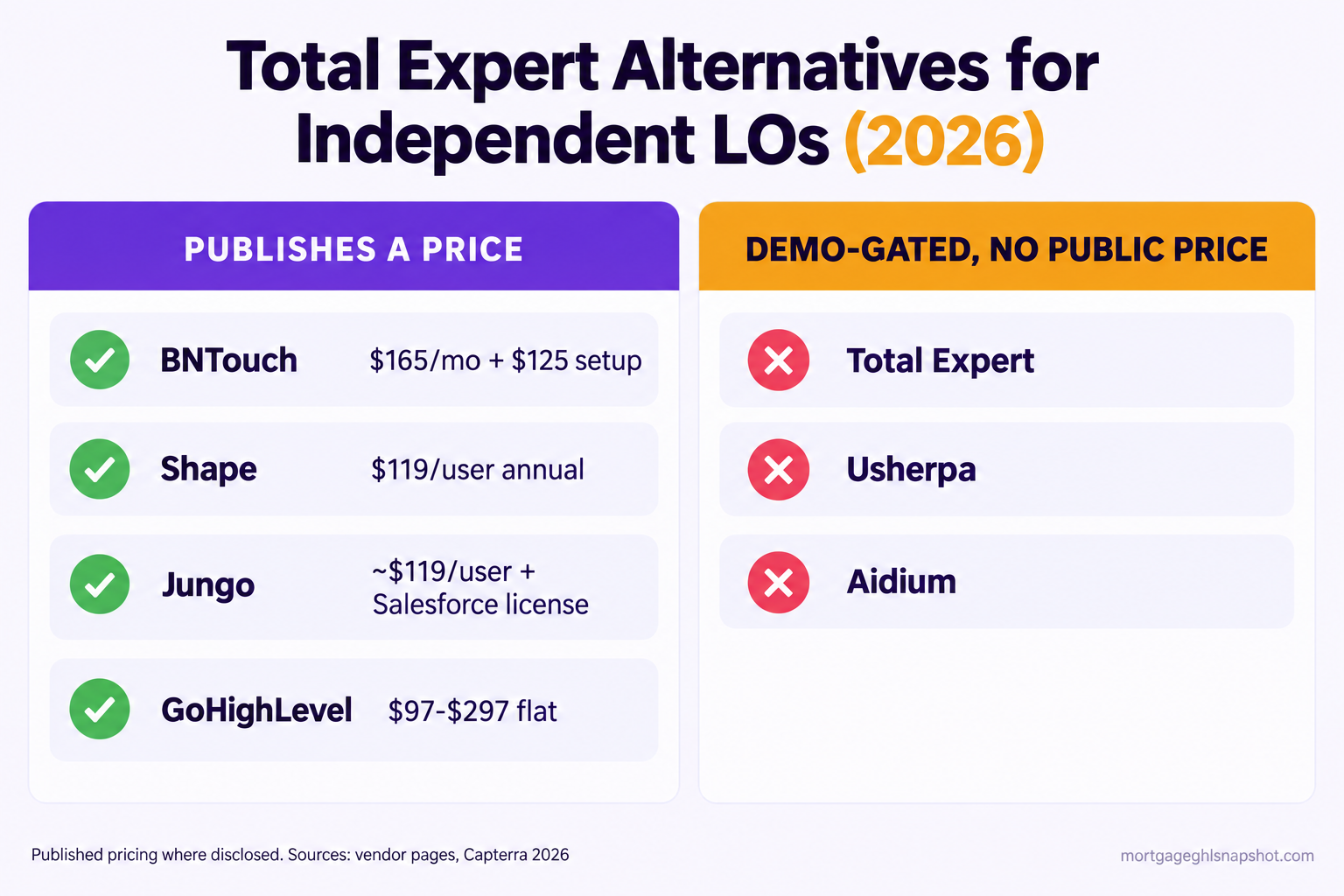
Here’s the short answer before you sit through another demo. Total Expert is priced for retail banks and large lenders, not independent originators, which is why it hides its price. The best alternatives for a small shop in 2026: BNTouch for a mortgage-native CRM with a published price, Jungo if you already live in Salesforce, Shape if sales-team features beat mortgage depth for you, and a flat-priced platform like GoHighLevel (with a done-for-you mortgage system on top) if you’re tired of paying per seat. Usherpa and Aidium round out the field but keep pricing behind a demo, same as Total Expert. Below: six options, eight things that decide the pick, and three worked scenarios.
Why independent LOs go looking for a Total Expert alternative
Total Expert is a capable platform. The problem is who it’s built for: retail banks, credit unions, and large lenders that need bank-grade compliance, deep core-system integrations, and a marketing team to run it. If that’s you, stop reading and book the demo. If you’re a loan officer running your own book, or an owner with a handful of LOs, three things push you toward the exit.
First is price you can’t see. Total Expert is quote-only, listed as “available on request” on the directories that track it (Capterra, 2026). Demo-gating lets a sales team price you by how big your shop looks, so a solo LO and a forty-person brokerage can leave the same demo with wildly different quotes for the same software. Second is scope: enterprise features built for compliance departments a five-person shop doesn’t have, on a seat that costs the same whether you touch them or not.
Third has nothing to do with logos. Your CRM is one of the few fixed costs you carry through a slow quarter, and it decides whether your past database turns back into loans: 88% of buyers still purchase through an agent or broker, and 66% of sellers found their agent through a referral or a past relationship, per the National Association of Realtors’ 2025 Profile of Home Buyers and Sellers (NAR, 2025). Paying enterprise money for a tool nobody opens is the worst outcome there is. Our 2026 mortgage CRM pricing teardown goes vendor by vendor on cost; this piece is the decision.
The eight things that actually decide the pick
Feature lists blur together. These eight questions change the answer for a small shop. Score every option against them, not a demo highlight reel.
- Is the price published? A vendor that shows a number can’t reprice you by headcount later.
- What does a solo LO really pay? Base price plus setup plus texting, in month one.
- How does per-user pricing scale? The single biggest hidden cost as you hire.
- How mortgage-native is it? 1003-style intake, LOS integration, pre-qual and rate-drop out of the box, or a generic CRM you bend into shape.
- What’s the setup and migration cost? Implementation fees plus the hours to move your database.
- What compliance tooling is included? Consent capture, opt-out handling, 10DLC help, NMLS-ID on outbound.
- What’s the contract and lock-in? Month-to-month, annual, or a multi-year deal with an export charge to leave.
- Who is it right for? Be honest about the shop size each tool serves.
The chart below shows the number that separates these tools fastest: what a five-LO team pays per month.
Monthly cost for a five-LO team, US dollars. BNTouch and Shape use published per-user pricing; Jungo combines its fee with a separate Salesforce license; GoHighLevel is flat; Total Expert is a third-party estimate because it publishes no price. Sources in each vendor section below.
The six alternatives, one by one
Here’s the field, and where each one bites.
BNTouch: the mortgage-native pick with an honest price
BNTouch is the cleanest like-for-like swap for a small shop. It’s built for mortgage, and it publishes its price instead of gating it. The Individual plan runs $165 a month plus a one-time $125 activation fee, and the Team plan is $95 per user per month with a two-user minimum (BNTouch pricing, 2026). You get mortgage-specific pipelines, marketing content, and LOS-aware fields out of the box.
Where it bites: the interface feels dated, and the Team rate still multiplies with every hire (near $475/mo at five seats, past $1,400 at fifteen). For a solo or small team, it’s the safe default.
Jungo: powerful, if you can pay the Salesforce tax
Jungo (the real one lives at ijungo.com, not the unrelated company at the .com) is a mortgage layer built on Salesforce. That’s its strength, everything Salesforce does well, and its trap: the bill. Jungo’s published price is roughly $96 to $119 per user per month, but that covers Jungo only. You also pay Salesforce directly, and the editions with the API access an integration needs list around $165 to $175 per user per month (Salesforce via G2, 2026). Add them up and a seat is closer to $280 to $315 a month, not the $119 on the page.
Where it bites: the true per-seat cost and the Salesforce learning curve. Right for a team already on Salesforce, painful for anyone who isn’t.
Shape Software: sales-forward, mortgage-adjacent
Shape markets itself as transparently priced, and the price is real: about $119 per user per month annually, or $149 month to month, with setup fees (a $299 and a $199 charge) waived on annual billing (Software Advice, 2026). It leans into dialers and lead distribution across several verticals.
Where it bites: it’s a sales CRM that does mortgage, not a mortgage CRM first, so some originator workflows need configuring. Best for a shop that runs like a sales floor.
Usherpa: relationship marketing, price behind a demo
Usherpa (once MyCRMDashboard) is built around staying in front of your past database with automated marketing, the muscle most originators let go slack. The catch is familiar: no published pricing, just a demo for a custom quote (SoftwareSuggest, 2026).
Where it bites: you’re back to the demo-gated dance you left Total Expert to avoid. Strong on nurture, slow to price.
Aidium: AI-forward, also demo-gated
Aidium (formerly Daily AI) is one of the newer, AI-heavy mortgage CRMs, pitching automated engagement and lead scoring. It’s modern, and keeps pricing custom, behind a demo (Capterra, 2026).
Where it bites: no public number, and as a younger platform it asks you to trust a roadmap. Worth a look if AI workflows are your priority.
GoHighLevel plus a mortgage system: the flat-priced escape from per-seat math
If per-user pricing is what’s driving you off Total Expert, the honest answer is a flat-priced platform. GoHighLevel publishes its plans openly: $97 a month Starter, $297 Unlimited, $497 SaaS Pro, with 17% off annually (GoHighLevel pricing, 2026). The Unlimited plan adds users without raising your platform fee. On its own it’s a blank platform, so you either build the mortgage workflows yourself or install a done-for-you system on top.
Where it bites: empty-box syndrome. The flexibility that makes it cheap at scale means it does nothing mortgage-specific until someone sets it up, which is the gap our prebuilt mortgage CRM and workflow automations fill. (GoHighLevel link above is our partner referral link; we may earn a commission if you sign up through it, at no extra cost to you.)
The side-by-side table
| Tool | Published price? | Solo LO cost | Mortgage-native | Per-seat scaling | Best for |
|---|---|---|---|---|---|
| BNTouch | Yes | ~$165/mo + $125 setup | High | $95/user (2 min) | Small shops wanting mortgage features + a real price |
| Jungo | Partial | ~$280–$315 all-in | High (on Salesforce) | Jungo + Salesforce per seat | Teams already on Salesforce |
| Shape | Yes (demo-forward) | ~$119/user annual | Medium | $119/user | Sales-floor operations |
| Usherpa | No | Quote only | High (nurture) | Quote only | Retention-focused shops |
| Aidium | No | Quote only | High (AI) | Quote only | AI-first early adopters |
| GoHighLevel + system | Yes | $97–$297 flat | Depends on the build | Flat, no per-seat tax | Teams escaping per-user pricing |
Figures are published pricing where disclosed; “quote only” tools were demo-gated as of September 2026. Confirm live pricing on each vendor’s page before you buy.
Three scenarios: solo, small team, brokerage
The right pick changes with the size of your shop. Here’s the decision run three ways.
The solo loan officer
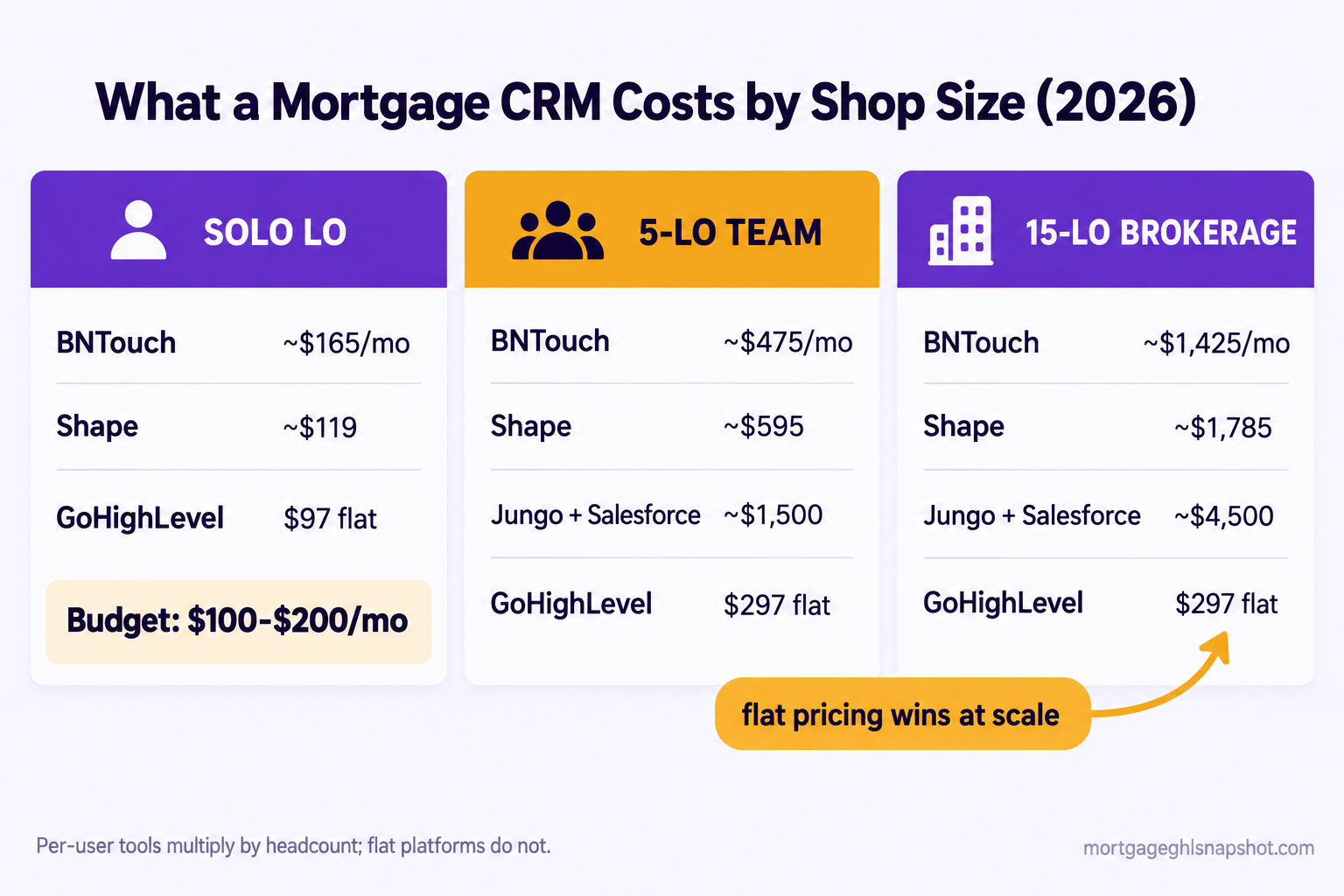
Per-user pricing barely stings when you’re the only user, so this is the one case where seat-priced tools stay competitive. BNTouch at ~$165/mo plus the $125 activation is a clean default, and Shape at ~$119/user is in range. Jungo looks cheap at $119 until you add the Salesforce seat, which makes it the priciest option here. A flat GoHighLevel Starter at $97 with a prebuilt mortgage system undercuts all of them. Realistic solo budget: $100 to $200 a month.
The small team (5 LOs)
Per-user math starts to hurt. At $95 a user, BNTouch Team is about $475/mo, Shape about $595, and Jungo plus Salesforce roughly $1,500/mo. A flat GoHighLevel Unlimited stays at $297 no matter how many of the five log in, which is where flat pricing starts winning. Total Expert, at a rough $400-a-seat estimate, would run near $2,000 before implementation.
The brokerage (15 LOs)
At fifteen seats, per-user pricing is the whole story. BNTouch Team is about $1,425/mo, Shape roughly $1,785, and Jungo plus Salesforce a $4,500-a-month decision. A flat platform is still $297, a gap of tens of thousands a year worth engineering your stack to avoid.
What breaks when you switch (and how not to lose your database)
Most originators stay on a tool they’ve outgrown out of fear of the move, and a bad migration can cost loans. Here’s where switches break.
Your data exports as a mess. The common failure is discovering halfway through that your old CRM exports contacts but drops the notes, tags, and loan history that made the database valuable. Run a full export and open the file before you cancel anything.
Your automations go dark on cutover. Flip the switch with no active nurture on the new platform and every borrower mid-sequence stops hearing from you for days. Build the core workflows on the new tool and test them with your own number and email first.
Consent and opt-outs don’t carry over. Opt-outs are legally binding, so a contact who replied STOP on the old system must stay suppressed on the new one. Import your opt-out list before a single message goes out. Our text message compliance guide covers preserving TCPA consent across a move.
Your 10DLC registration resets. Moving platforms usually means re-registering your A2P 10DLC campaign, which takes days and pauses texting. Start it the week before cutover, not the day of.
Steal this: five questions that force a real price
For Total Expert, Usherpa, and Aidium, you can’t compare on price without extracting it. Read these out, in order, before the demo.
The cost no alternative removes: compliance
Switching tools changes your bill, not the rules, and this is the most regulated marketing environment any small operator works in. Whichever logo ends up on your login screen, four things are yours to get right.
RESPA Section 8. Paying for referrals is banned outright, and a lawful marketing services agreement has to be for payments “reasonably related to the value of services actually performed” (12 CFR 1024.14(g)). No per-referral payments to realtors, no cost-splits scaled to lead volume. Our RESPA-safe realtor co-marketing guide walks the line in detail.
The SAFE Act. Your NMLS ID belongs on your advertising. A CRM can add it to outbound templates automatically, but the responsibility is yours.
TCPA and A2P 10DLC. Every automated text needs prior express consent and a working opt-out, and your traffic has to be registered through 10DLC. Carrier fees on that traffic are a real line item no CRM waves away.
UDAAP on any rate or APR claim. The moment you put a number in a message, it has to be accurate and not misleading, which is why our system treats calculator outputs as estimates and never quotes live rates. Software builds guardrails; it can’t make a non-compliant offer legal. Pick the tool that makes the right thing the easy default, then own the rules yourself.
Common objections, answered
“I’m mid-contract with Total Expert. Doesn’t that lock me in?”
Until renewal, yes, and you shouldn’t eat an early-termination fee for no reason. Use the time: build your shortlist, export a clean copy of your data now while you have full access, and line up the new platform to move the week your term ends, before it auto-renews.
“Do I need to be technical to run a flat platform like GoHighLevel?”
Somewhat, if you build it from scratch, because a general-purpose tool does nothing mortgage-specific until it’s set up. So don’t. A done-for-you mortgage system arrives with borrower capture, pre-qual, and rate-drop refi alerts already wired, so you get flat pricing without the empty-box problem.
“Won’t a cheaper tool miss the mortgage features Total Expert has?”
You’ll lose some enterprise features, and if you need bank-grade compliance tooling and core-system integrations, Total Expert may still be your answer. But most independent LOs use a fraction of that. What moves your numbers is speed-to-lead, consistent nurture, and reactivating a database you’ve let go quiet, which every tool here does for a fraction of the price.
Frequently asked questions
Frequently asked questions
What is the best Total Expert alternative for a solo loan officer?
BNTouch is the cleanest pick at around $165/mo plus a one-time $125 activation, with mortgage features and a published price. If you'd rather have flat pricing and room to grow, GoHighLevel Starter at $97/mo with a prebuilt mortgage system undercuts it. Avoid Jungo as a solo, since the Salesforce license makes it the priciest option.
How much does Total Expert actually cost?
Total Expert doesn't publish pricing. It's demo-gated, quote-only, and priced for enterprise lenders. Third-party estimates land near $300 to $600 per user per month, but no one outside a signed contract knows, which is why the demo comes before the price.
Why is Jungo more expensive than its price page shows?
Jungo runs on Salesforce, so its published ~$96 to $119 per user covers Jungo only. You also pay Salesforce directly, at around $165 to $175 per user for the editions with API access. All-in, a seat is roughly $280 to $315, not $119.
Is per-user or flat pricing better for a small brokerage?
Flat pricing almost always wins past a few seats. At $95 per user, five LOs is about $475/mo and fifteen is about $1,425/mo, climbing with every hire. A flat-rate platform charges once and lets you add users without the multiplier.
Do any of these CRMs keep me compliant with RESPA and TCPA?
No. RESPA Section 8 bans paying for referrals, the SAFE Act requires your NMLS ID on advertising, and TCPA plus A2P 10DLC govern every text. Software builds guardrails; the legal responsibility and 10DLC carrier fees are yours.
The bottom line. Total Expert isn’t a bad platform, it’s just priced for someone bigger than you. BNTouch is the honest mortgage-native default, Jungo suits Salesforce shops that can pay the second license, Shape fits a sales floor, and a flat platform with a done-for-you mortgage system is the escape hatch from per-seat math. Pick on the eight criteria, migrate your opt-out list first, and remember the tool never owns your compliance. You do.
Meera Sundaram is a mortgage marketing strategist. This article is educational, not legal or compliance advice; confirm current pricing on each vendor’s own page and consult counsel on RESPA, TCPA, and state advertising rules before you act.