
A realtor you have closed six loans with slides a photo across the closing table. It is a glossy postcard, both of your headshots, both logos, “Sold in Riverside by the team that gets it done.” She loves it. She wants to run it to her whole farm every month. Then she says the line that should make your stomach drop: “You cover the printing, I will cover the mailing list, deal?”
That is the moment RESPA Section 8 walks into the room. Say yes the wrong way and you have not built a partnership, you have built the exhibit a regulator staples to a consent order. Co-marketing with agents is legal and one of the best things a loan officer can do. It is also the most audited relationship in the business, because it sits on the federal law that bans paying for referrals. This guide is the plain-English version: what Section 8 prohibits, which structures survive scrutiny, the documentation that keeps you clean, and sample language you can lift into your own agreements.
What RESPA Section 8 actually bans
Strip out the legalese and Section 8 says one thing: you cannot give or accept a fee, kickback, or “thing of value” in exchange for the referral of settlement-service business on a federally related mortgage. That covers you, the agent, the title company, everyone in the chain (CFPB, 12 CFR 1024.14). A “thing of value” is read broadly. Cash is obvious, but so is paying a bill that was properly the agent’s, or covering their share of an ad because they feed you loans.
The regulation does carve out real payments: you can pay fair-market value for goods or services actually furnished. Here is the sentence that decides most cases. If a payment bears no reasonable relationship to the market value of what was actually provided, the excess is treated as a payment for the referral, which is illegal. And the value of the referral itself, the extra business you expect, is never counted toward the value of the service (CFPB, 12 CFR 1024.14). So “I paid her $500 a month and she sends me deals, so it is worth it” is not a defense. It is a confession.
The consequences are not theoretical.
Those figures come straight from the statute at 12 U.S.C. 2607: up to a $10,000 fine or a year in prison, and civil liability of three times the tainted charge plus attorney fees. State regulators can pile on with license actions. A single sloppy deal can cost you the business and the license that lets you run it.
Why co-marketing is where loan officers get caught
Referrals are the lifeblood of this job, which is the problem. In the 2025 NAR Profile of Home Buyers and Sellers, 88% of buyers bought through an agent and 66% of sellers found their agent by referral or repeat business. When an agent controls that much of the funnel, every originator wants a spot on their short list, and money is the laziest way to try to buy one. That is the behavior Section 8 exists to stop.
For years the CFPB was quiet on this and a lot of shops got comfortable. That ended. In August 2023 the CFPB ordered Freedom Mortgage to pay $1.75 million and hit a partner brokerage, Realty Connect, with a separate $200,000 penalty. The finding was blunt: subscription services, events, and gifts flowing to brokerages were “a method to pay for mortgage referrals, rather than compensate the brokerages for marketing services they actually performed” (CFPB, 2023). It was the Bureau’s first public Section 8 action since 2017. The pause is over.
Penalties in the CFPB’s August 2023 RESPA action for disguised referral payments. Source: CFPB enforcement records, 2023. The brokerage got fined too.
Notice who paid: both sides, and the lender took the larger hit. When one of these deals unwinds, the loan officer who set it up has their name on the emails.
Five co-marketing structures that survive an audit
Here is the good news you came for. There are real, defensible ways to market alongside a realtor. Each works because it pays for a genuine service at a fair price and never for the referral, and each breaks in a predictable way, so I have flagged how.
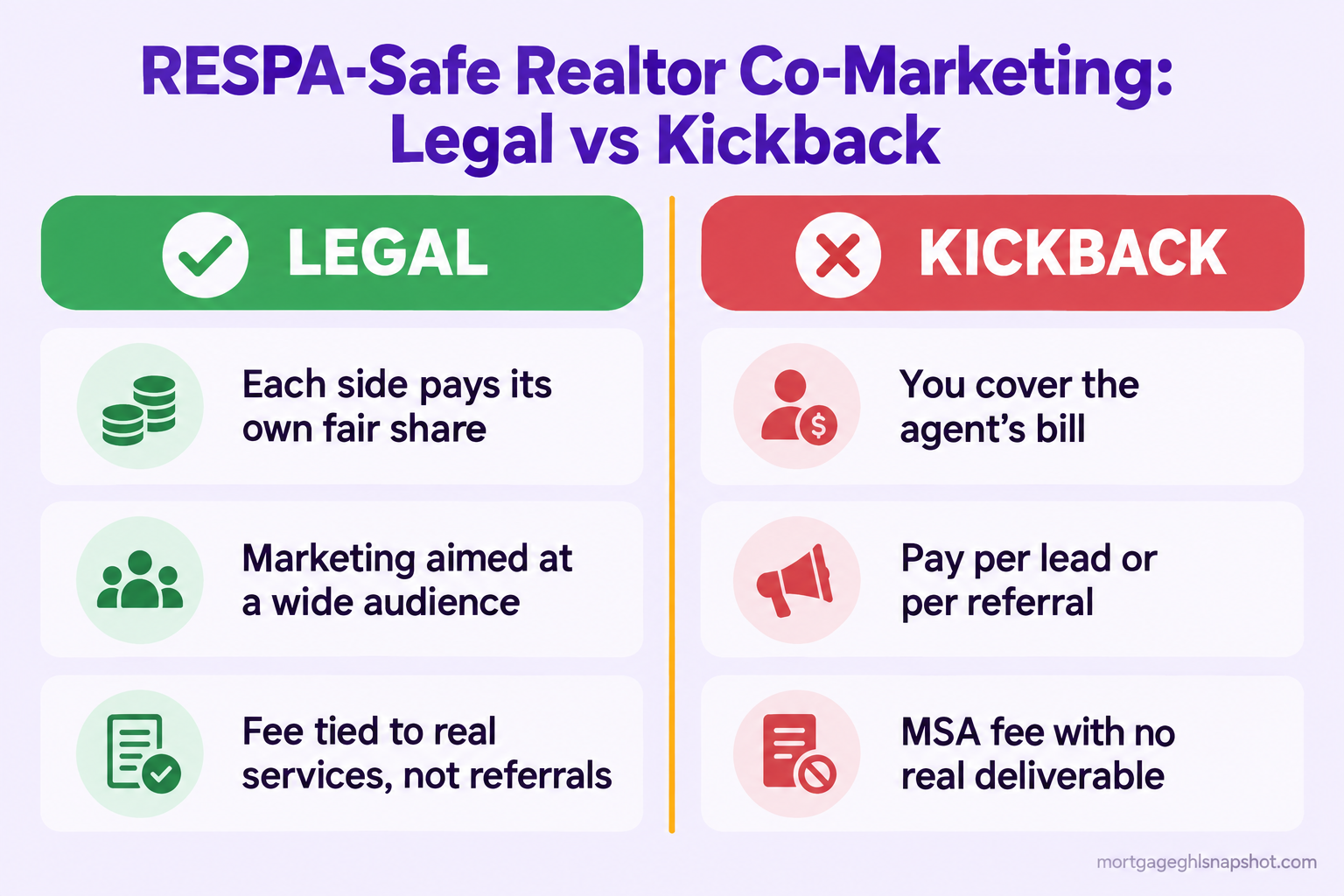
1. Cost-shared co-branded marketing, split by fair share
You and an agent produce a piece that promotes both of you, a postcard, a homebuyer seminar, a social ad, and each side pays its fair share. If your logo, photo, and message take up half the postcard, you pay roughly half. The CFPB treats advertising placed in widely circulated media as a marketing service, not a referral, because it is aimed at a broad audience rather than one person (CFPB RESPA FAQs).
How it breaks: you quietly pay 80% of a 50/50 piece, or you keep funding “joint” ads that only ever feature the agent. The moment your share of the cost stops matching your share of the space, the extra is a thing of value for referrals. Keep the invoice, the proof, and a note on the split.
2. Marketing Services Agreements, written and priced honestly
An MSA is a contract where you pay a partner a set fee for defined marketing services: a certain number of social posts, a booth at their office, a monthly email feature. The CFPB has been explicit that entering into and paying under MSAs is not, by itself, prohibited (CFPB, 2020). The fee has to be fair-market value for services actually performed, and it cannot rise or fall with how many loans come back.
How it breaks: the fee is a round number nobody can tie to a deliverable, the services never happen, or payment flows in months the “marketing” produced nothing. An MSA that is really a flat monthly payment for staying friendly is the classic disguised kickback. If you cannot show what you got for the money, do not sign it.
3. Normal promotional and educational activities
You can do normal promotional and educational things for referral sources: host a first-time-homebuyer class, teach a lunch-and-learn on VA loans, send a useful market update. RESPA permits this on two conditions: the activity is not conditioned on referrals, and it does not pay expenses the agent would otherwise cover themselves (CFPB RESPA FAQs).
How it breaks: you “sponsor” the agent’s Friday happy hour, cater their team meeting, or buy the office coffee. Now you are defraying their operating costs, which is a thing of value. Teaching is fine. Subsidizing overhead is not.
4. Advertising services, not access to a person
The cleanest line the CFPB drew is between a marketing service and a referral. A marketing service is aimed at a wide audience: an ad in a paper, a trade publication, a website. A referral is an action directed at a specific person to steer them to you (CFPB RESPA FAQs). Pay for the first, never the second.
How it breaks: you buy a “featured lender” spot that is really the agent recommending you to each buyer at the table, or a platform fee that scales with the leads it hands you. When your payment buys endorsements to named people or a per-lead price, the invoice label does not save you.
5. Co-branded tools and calculators, each paying its own way
Shared technology is where a lot of modern co-marketing lives: a co-branded mortgage calculator on the agent’s site, a joint landing page, an app you both appear in. This is fine when each party pays fair value for its own use and neither covers the other’s cost as a reward for volume.
How it breaks: you buy the agent a premium software seat “so we can work together,” and the seat is really compensation for the loans it routes you. If you are paying for their tool rather than your genuine share of a joint tool, you are back in kickback territory. It is the same discipline that keeps your texting on the right side of the TCPA.
Solo LO, small brokerage, and partner team
The rules are the same at every size, but the practical risk and the paperwork change. Here is how I coach each.
The solo loan officer. Your exposure is usually one or two informal deals with agents you like, and that is where the “you cover printing, I cover the list” handshake lives. It is the most dangerous kind, because nothing is written down. Co-brand pieces where you each pay your own share, keep the receipts, and skip the freebies. A solo originator rarely needs a formal MSA.
The small brokerage with 2 to 15 LOs. Now several originators are cutting their own side deals, which is a supervision problem: one LO’s disguised kickback becomes the company’s enforcement action. You need a written co-marketing policy, a single approval step before any arrangement goes live, and a shared folder where every split, invoice, and MSA lives.
The team built on realtor partnerships. If agent co-marketing is your primary channel, treat compliance as infrastructure. Every MSA gets counsel review, fair-market-value backup, and a quarterly check that services happened. This is where a real system pays for itself: the platform that runs database reactivation and rate-drop alerts can timestamp every co-marketing touch as evidence. Pair this with our realtor referral partnerships playbook for the growth side of the same relationship.
Steal this: compliant language and the paper trail
None of this is legal advice, and you should run your own agreements past qualified counsel. These are the building blocks to start from.
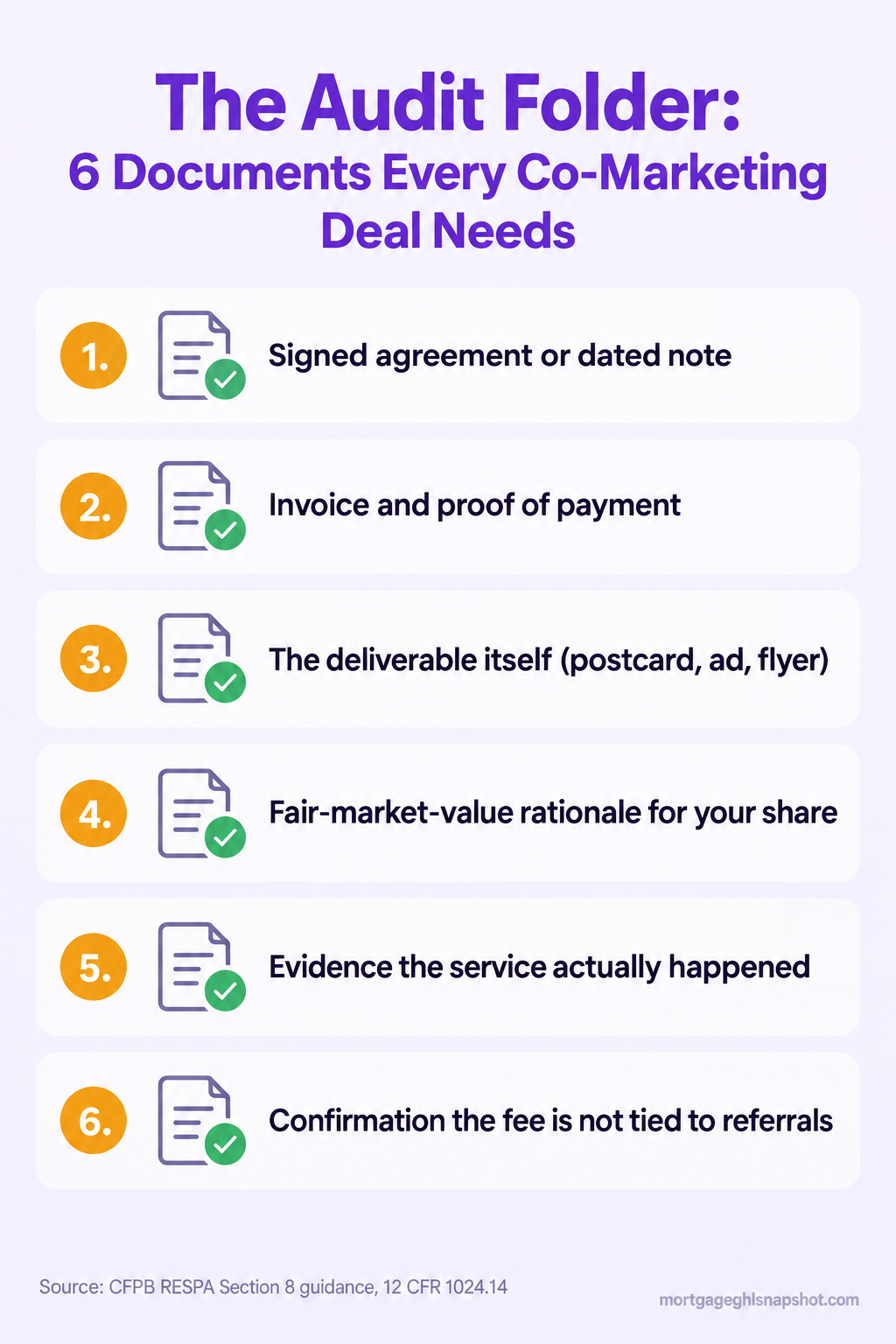
Write the reasoning down while the deal is fresh and cheap, so you never have to invent it later when it is expensive. An arrangement you can explain in one paragraph, with receipts, is one you can defend.
Check your state: the rules that change by line on a map
RESPA is federal and applies everywhere, but your advertising disclosures are governed by state law too, and those genuinely differ. Two examples every co-marketing piece must respect.
In California, advertising for a loan disseminated primarily in the state must disclose the license under which the loan is arranged, and for DRE-licensed brokers that means the real estate broker license number in addition to the NMLS unique identifier (California DRE). Most states want only the NMLS ID. California wants both, so a co-branded postcard that omits the DRE number is noncompliant on its face.
In Texas, 7 TAC 56.203 requires an ad to disclose the company’s name and NMLS ID, plus the sponsored originator’s name and NMLS ID when one is behind it, and you cannot use graphics or shading to bury it. A joint ad with an agent still has to carry your company and originator identifiers cleanly.
On the federal side, the SAFE Act requires you to give your NMLS identifier to consumers on request, before acting as an originator, and in your first written communication (12 CFR 1008). The “NMLS ID on every ad” habit most originators follow actually comes from state rules, not the federal SAFE Act, so when you co-market across a state line, build to the stricter rule.
The objections I hear every week
“My competitor pays agents for leads and nothing has happened to them.” Not yet. Enforcement runs in waves, and the 2023 Freedom action showed the CFPB can go quiet for years and then move hard (CFPB, 2023). “Everyone does it” is what every defendant says in the deposition. Do not be the example.
“Isn’t an MSA just a legal kickback with extra steps?” No, and that distinction is the whole game. A real MSA pays fair value for marketing that genuinely happens, priced without reference to referrals. A kickback pays for the referrals and hides behind a marketing label. If the services are real and fairly priced, an MSA is defensible. If they are theater, no contract saves it.
“The 2015 bulletin was rescinded, so MSAs are fine now, right?” This is the most dangerous misread out there. The CFPB rescinded its 2015 MSA bulletin in 2020, but it did so because the bulletin lacked clarity, not because it blessed MSAs. The Bureau was explicit that rescission does not make MSAs presumptively legal, and the statute never changed (CFPB, 2020). The facts of your deal still decide everything.
“Do I need a lawyer for every postcard?” No. For simple cost-shared pieces where each side pays its fair share, a documented split and a fair-value note are enough. Bring in counsel when money changes hands on a recurring basis: MSAs, sponsorships, anything with a monthly fee or a platform that touches lead volume.
The originators who win are not the ones who pay the most. They are the ones agents trust because they answer buyers fast and make the agent look good. No kickback can buy that edge.
Back to that postcard on the closing table. The right answer is not “no.” It is: “Love it. Let’s each cover our own half, I’ll email you the split so we both have it on file, and I’ll get my buyers answered in minutes so your clients rave about you.” She still gets her postcard, you still get the deals, and what you built holds up.
Frequently asked questions
Is it legal to co-market with a real estate agent under RESPA?
Yes. Co-marketing is legal when each party pays fair-market value for its own share of a genuine marketing service and no payment is made for referrals. The problem is never the co-marketing itself, it is paying more than your fair share, or paying for access to specific clients. See CFPB guidance at 12 CFR 1024.14 (https://www.consumerfinance.gov/rules-policy/regulations/1024/14/).
Can I pay a realtor for mortgage referrals if I call it a marketing fee?
No. RESPA Section 8 prohibits any fee, kickback, or thing of value given for the referral of settlement-service business, and calling a referral payment a 'marketing fee' does not change what it is. If the payment bears no reasonable relationship to the market value of a service actually performed, the excess is treated as an illegal referral payment (12 U.S.C. 2607).
Are Marketing Services Agreements (MSAs) still allowed in 2026?
Yes. Entering into and paying under an MSA is not by itself prohibited. The fee must be fair-market value for marketing services actually performed, and it cannot vary with the number or value of referrals. The CFPB rescinded its 2015 MSA bulletin in 2020 but was clear that this does not make MSAs presumptively legal. The facts of each arrangement decide.
What are the penalties for a RESPA Section 8 violation?
Criminal penalties reach a fine of up to $10,000 or one year in prison per violation. Civil liability in a private suit is three times the amount of the charge for the settlement service, plus attorney fees and costs. State regulators can also bring license actions (12 U.S.C. 2607).
Can I buy a realtor lunch or a closing gift without violating RESPA?
Normal promotional activity is allowed only if it is not conditioned on referrals and does not defray expenses the agent would otherwise incur. There is no dollar threshold that is automatically safe. A one-off closing gift given regardless of referrals is generally fine; a recurring pattern of paying the agent's costs in exchange for business is a thing of value and a violation.
What records do I need to defend a co-marketing arrangement in an audit?
Keep the signed agreement or a dated note, the invoice and proof of payment, the deliverable itself, a fair-market-value rationale for your share, evidence the service was performed, and confirmation the fee is not tied to referral volume. Documentation created when the deal is made is far stronger than anything reconstructed later.