
It is 6:50pm on a Thursday and you are at your kid’s game when a lead form hits your website. Your CRM captured the lead. It did not text them. Your dialer does not know they exist. By the time you see the email at 9pm, they have already talked to two other loan officers and booked with one. You did everything right. You bought the CRM, the dialer, the point-of-sale, the texting app. And you still lost the deal.
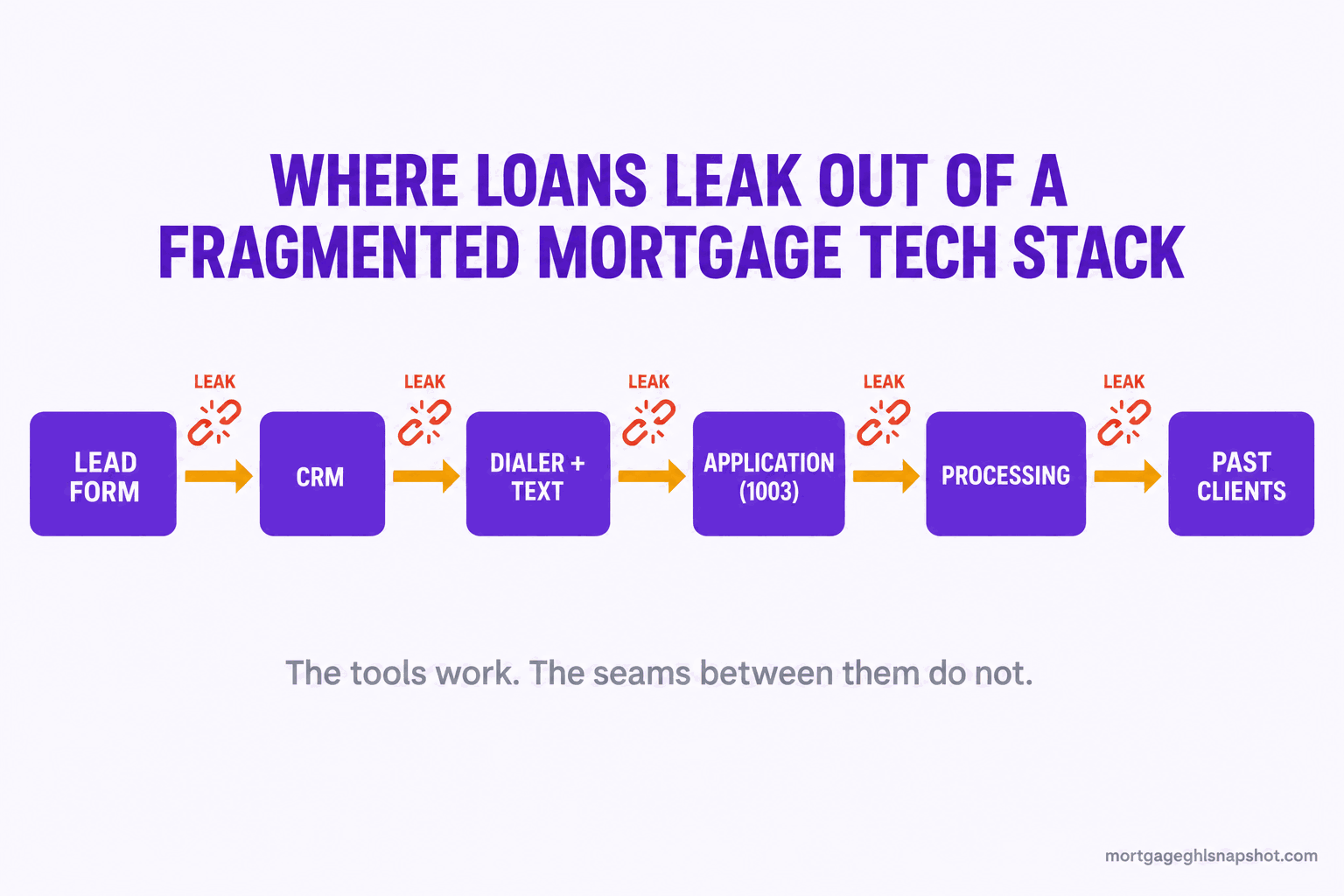
Here is the part most originators miss. That borrower did not leak out of a tool, they leaked out of the gap between two tools. Your software did not fail, the handoff failed, because nothing connected the lead form to the text and the text to your calendar. A fragmented tech stack loses deals in the seams, and the seams stay invisible until you go looking. This guide walks every seam where loans fall out, and gives you the messages and fixes that close them.
What a fragmented stack actually costs you
Start with the number that should keep you up at night. In the third quarter of 2025, independent mortgage banks spent an average of $11,109 to produce a single loan and kept just $1,201 in net production profit per loan (Mortgage Bankers Association). One good borrower lost in a handoff gap does not cost you one loan, it wipes out the profit from a stack of clean closings.
Sources: MBA Quarterly Mortgage Bankers Performance Report, Q3 2025; NAR 2025 Profile of Home Buyers and Sellers.
That per-loan cost has stayed above $11,000 all year (MBA). A stack that leaks borrowers along the way is the most expensive problem nobody has priced.
And the leaks compound, because mortgage is a referral and repeat business. In the 2025 NAR profile, 88% of buyers purchased through an agent and 91% said they would use their agent again or recommend them (NAR 2025 Profile). When your stack drops a borrower, you lose the loan, their refinance in three years, and the two friends they would have sent you.
The borrower journey and where the seams are
A borrower moves through your business in stages: a lead comes in, you make first contact, you qualify them, they apply, the file goes through processing, it closes, and then they become a past client who should refinance and refer. Every stage probably lives in a different tool, and each boundary between two tools is a seam where the borrower waits for a human to notice and move them along. When you are busy, and you are always busy, the borrower sits. Below are the six seams, what breaks at each one, and the trigger that closes it.
The six handoffs where loans leak out
Handoff 1: Lead form to first contact
A borrower submits your form and nothing reaches them for hours. Your CRM logged the lead but did not text them, and you were on a call or off the clock. Research on online sales leads found firms contacting a new lead within an hour were far more likely to qualify it than firms that waited (Harvard Business Review, 2011). A borrower shopping a rate is calling three lenders, and the first human reply usually wins.
Why it leaks: capturing a lead and responding to a lead are two different jobs, and most stacks do the first without triggering the second. The response then depends on you seeing a notification, which is exactly what fails when you are busy.
What closes it: one trigger on the form submission that fires an instant text and email, offers a time to talk, and only then pings you. The full case for sub-minute response is in our guide to mortgage speed-to-lead, and the fix for calls you miss is in missed-call text-back for loan officers.
Handoff 2: First contact to the CRM record
You call the borrower back from your cell and the details live in your head and your call history. Your CRM has no idea the call happened, so the next follow-up never gets scheduled.
Why it leaks: your dialer and your CRM are separate, so every conversation outside the CRM is invisible to it. Manual logging is the fix nobody keeps up with after week two.
What closes it: a phone and texting layer that lives inside the CRM, so every call attaches to the contact and the next task gets created the moment the call ends. No re-keying required.
Handoff 3: Qualified borrower to the application
The borrower is ready to apply, so you email them a link to a point-of-sale tool that knows none of what you just collected. They re-enter their name, email, phone, and loan purpose, and some stall on the re-entry and never finish. You handed a motivated borrower a speed bump at the worst moment.
Why it leaks: the data you already captured does not travel to the application, so the borrower repeats themselves and friction creeps in where momentum matters most.
What closes it: the intake and the application share one record, so the fields you already have pre-fill and the borrower starts the 1003-lite most of the way done. The handoff becomes a click, not a fresh form.
Handoff 4: In-process file to status updates
The loan is in processing and the borrower goes quiet, then anxious, then starts calling your cell for updates. The realtor is texting you too. You are the integration layer, pulling status from one system into messages for two audiences. When you get slammed the updates stop, and a nervous borrower listens to a competitor’s pitch.
Why it leaks: status lives in your processing system and has to be carried, by you, into texts and emails, and that manual carry is the first thing to drop when volume spikes.
What closes it: milestone triggers. When the file hits appraisal ordered, conditional approval, or clear to close, the system sends the borrower and the agent a plain-language update on its own. The playbook on holding a borrower through processing is in why pre-approvals go quiet and never close.
Handoff 5: Closed loan to past-client follow-up
This is the biggest leak, and almost no stack even attempts it. The loan closes and the borrower falls off the edge of your tools into a spreadsheet nobody opens. Two or three years later, when rates make their loan worth refinancing, the lender who sent a timely alert gets the deal. It is usually not you, because nothing in your stack fires at “it has been a year since this person closed.”
Why it leaks: closing is where most tools consider the job done, so there is no owner and no trigger for the years of repeat and referral value that follow.
What closes it: an automatic post-close track with annual reviews, rate-watch alerts, and a review request at the moment of highest trust. We break down the recovery in mortgage database reactivation, and the automations worth building first in five mortgage automations.
Handoff 6: The consent trail across every tool
Here is the leak that does not cost you a deal, it costs you a fine. A borrower opts in on your web form, replies STOP to a text in your messaging app, and asks to be emailed only in a third tool. If those systems do not share one record, you have three partial pictures of consent and no reliable answer to the question that matters in an audit: did this person agree, and did they opt out.
Why it leaks: consent and opt-out events get recorded in whichever tool they happen in, so the truth is scattered. A STOP in your dialer that never reaches your email tool means you keep emailing someone who told you to stop.
What closes it: one contact record that logs every opt-in and opt-out across every channel, so a STOP anywhere is honored everywhere. The full rules are in mortgage text message compliance in 2026.
Steal this: the handoff messages that stop the leak
You do not need clever copy, you need honest messages that fire on the right trigger so no borrower waits on you to remember. Adapt these to your voice, include your NMLS ID where advertising rules require it, and give a clear opt-out on any automated text. These are templates, not legal or rate advice.
Wire each one to a trigger that already exists in your pipeline, a form submission or a closing date, instead of your memory, and the handoffs close themselves.
Solo LO, small team, and a high-volume shop
The seams are the same at every size. What changes is which ones hurt most and how you close them.
The solo loan officer. You are the integration layer, so every handoff depends on you personally, which is why they fail when you get busy. Start with Handoff 1 and Handoff 5, the fastest payback: the instant lead reply so you never lose a fresh inquiry, and the post-close rate-watch track so you stop leaking refinances you already earned. Keep the referral touches personal, because at your size a message that clearly came from a human beats any template.
The small team, three to fifteen LOs. Your problem is ownership and consistency. A borrower closed by an LO who left last year is a borrower nobody is watching, and a STOP one LO recorded on their phone is invisible to the rest of the team. Standardize all six handoffs as one shared workflow and keep every record in one place, so a departing LO does not walk out with the relationships or leave a compliance gap behind.
The high-volume shop. At scale, nothing can depend on anyone remembering anything. Every handoff has to fire off data: loan type, milestone, closing date, time since last contact. Segmentation becomes automatic, so a 2022 FHA borrower and a 2021 jumbo borrower get different post-close outreach without a human sorting a list. The consent trail especially has to be centralized, because at high volume a scattered opt-out record is a certainty.
Now the part that makes the decision for most shops: what you pay for the privilege of a fragmented stack. Here is the published monthly list price of common standalone mortgage tools against one all-in-one platform that does the same jobs under a single record.
Published monthly list prices, solo or per-user. Sources: BNTouch ($165/mo individual); Floify ($99/user/mo); Jungo ($96/user/mo billed annually, plus a $249 setup fee and a separate required Salesforce license of roughly $25 to $300/user/mo); GoHighLevel (from $97/mo). A split stack pays several of these at once.
The chart understates the gap, because the standalone prices are per tool. Run a CRM, a POS, a dialer, and a scheduler separately and you pay several of those numbers at once, plus a connector tax and the hours you spend being the glue. Our breakdown of what mortgage CRM software actually costs in 2026 walks the hidden fees line by line.
The consent trail that has to survive the stack
Closing these handoffs puts you in automated contact with borrowers and realtors, so the law is in play, and a fragmented stack is where compliance quietly breaks. This is not legal advice, just the short list.
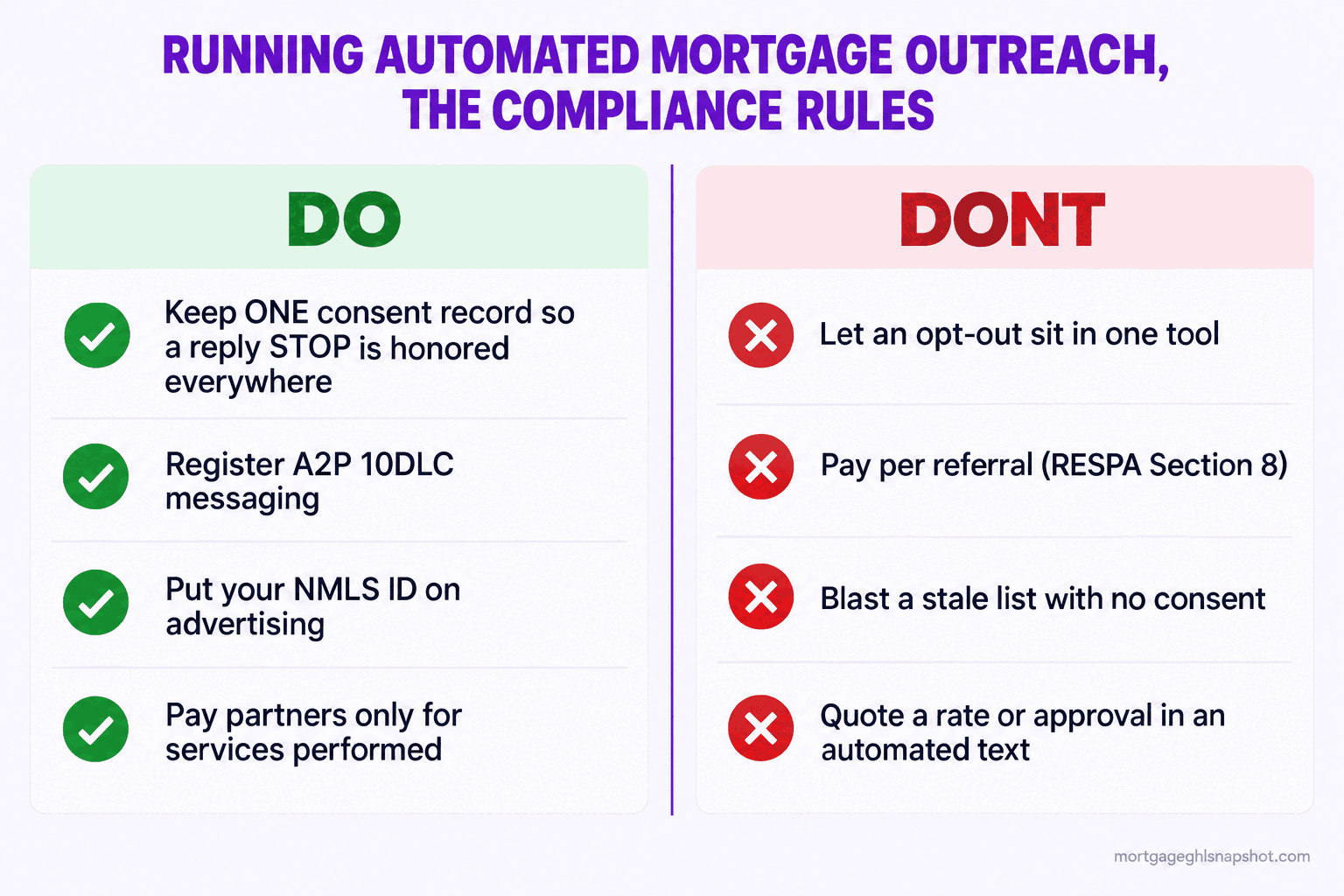
The single record that fixes your pipeline leaks is the same record that fixes your consent problem. When every opt-in and opt-out lives in one place, a STOP anywhere stops everything, and you answer the auditor in one screen instead of three.
The objections I hear every week
“I already pay for a CRM. Isn’t this what it does?” A CRM stores contacts. The leaks happen in the triggers between tools, and most CRMs do not reach into your dialer, POS, or calendar to fire them. The value is not another database, it is the automation that moves a borrower from one stage to the next without you. Our rundown of what a mortgage CRM should actually do separates the two.
“Ripping out my tools sounds like a nightmare.” It is less disruptive than you think, because you are not replacing one tool at a time, you are collapsing several into one and deleting the seams. You keep your number, your pipeline, and your contacts. What you lose is the four logins and the carrying between them.
“Won’t borrowers find the automated texts annoying?” Only if the texts are empty. An instant reply with a real time to talk, a milestone update a nervous borrower actually wants, a heads-up that their rate is worth a look: those read as service, and opt-out rates stay near zero. What annoys people is the empty “just checking in” text.
“I am a solo shop. Isn’t an all-in-one platform overkill?” It is the opposite. Solo is where a fragmented stack hurts most, because you are the only integration layer and have the least time to be it.
Frequently asked questions
Why do I keep losing leads even though I pay for good software?
Because capturing a lead and responding to a lead are different jobs, and a fragmented stack usually does the first without triggering the second. The form logs the lead but nothing texts the borrower, so your response waits on you noticing a notification while a competitor replies first.
Is it cheaper to use one all-in-one platform or several specialized tools?
For most small shops, one platform is cheaper and less work. Standalone tools add up fast: a CRM around $165/mo, a POS near $99/user/mo, plus a dialer, a scheduler, and a connector tax. An all-in-one platform starts near $97/mo, though a very large lender with deep LOS requirements may still need specialized systems.
How do I fix the handoff between my CRM and my application?
Use a system where the intake and the application share one contact record, so the name, email, phone, and loan purpose you already collected pre-fill the 1003-lite. That turns the application into a one-click continuation instead of a fresh form the borrower can abandon on re-entry.
What is the single highest-return handoff to fix first?
For most originators it is the instant lead reply, because a fresh inquiry is contacting several lenders and the first human response usually wins. Right behind it is the post-close rate-watch track, which recovers refinances from borrowers you already closed.
Does consolidating tools create a compliance risk?
It usually reduces one. TCPA opt-outs and SAFE Act disclosures break when consent is scattered across tools that do not share data. One record that logs every opt-in and opt-out means a reply STOP is honored everywhere, which is easier to prove in an audit than three partial records.
It is 6:50pm on a Thursday a year from now and you are at the game again. A lead hits your site. This time the borrower gets a text within seconds offering a time to talk, books a slot, and the details are waiting in one record before you ever look at your phone. You did not do any of it in the moment, because you built it once into the seams where your business used to leak. The tools were never the problem. The gaps between them were, and now they are closed.