
It is Monday morning and you just wired another $600 to the lead vendor. Ten fresh leads land before coffee. You call the first one. Voicemail. The second: “Who is this?” You work down the list, leave messages, send texts, and by Wednesday the batch is cold. By Friday you have decided these leads were junk, so you buy ten more and do the exact same thing. Three weeks later your card gets charged again and you still have not funded a loan off any of it.
Here is the part nobody selling you leads says out loud: the leads are probably fine. The problem is what happens in the ninety minutes after they hit your inbox, and in the ninety days after that. A bought mortgage lead is a stranger who clicked a rate form and got handed to four or five loan officers at once. The one who closes is almost never the one with the best rate. It is the one who called back first and then kept showing up. This guide is the six-stage system that turns a cold, shared, sixty-dollar lead into a funded loan, with the scripts, timing, and consent rules that keep it legal.
What a batch of bought leads actually costs you
Start with the real price, because the sticker is the smallest part of it. A conventional or FHA internet lead runs about $20 to $100, a VA lead $50 to $150, and a jumbo lead $100 to $200, and those are vendor estimates (Phonexa, 2025). Buy ten VA leads and you are out a thousand dollars before a phone rings.
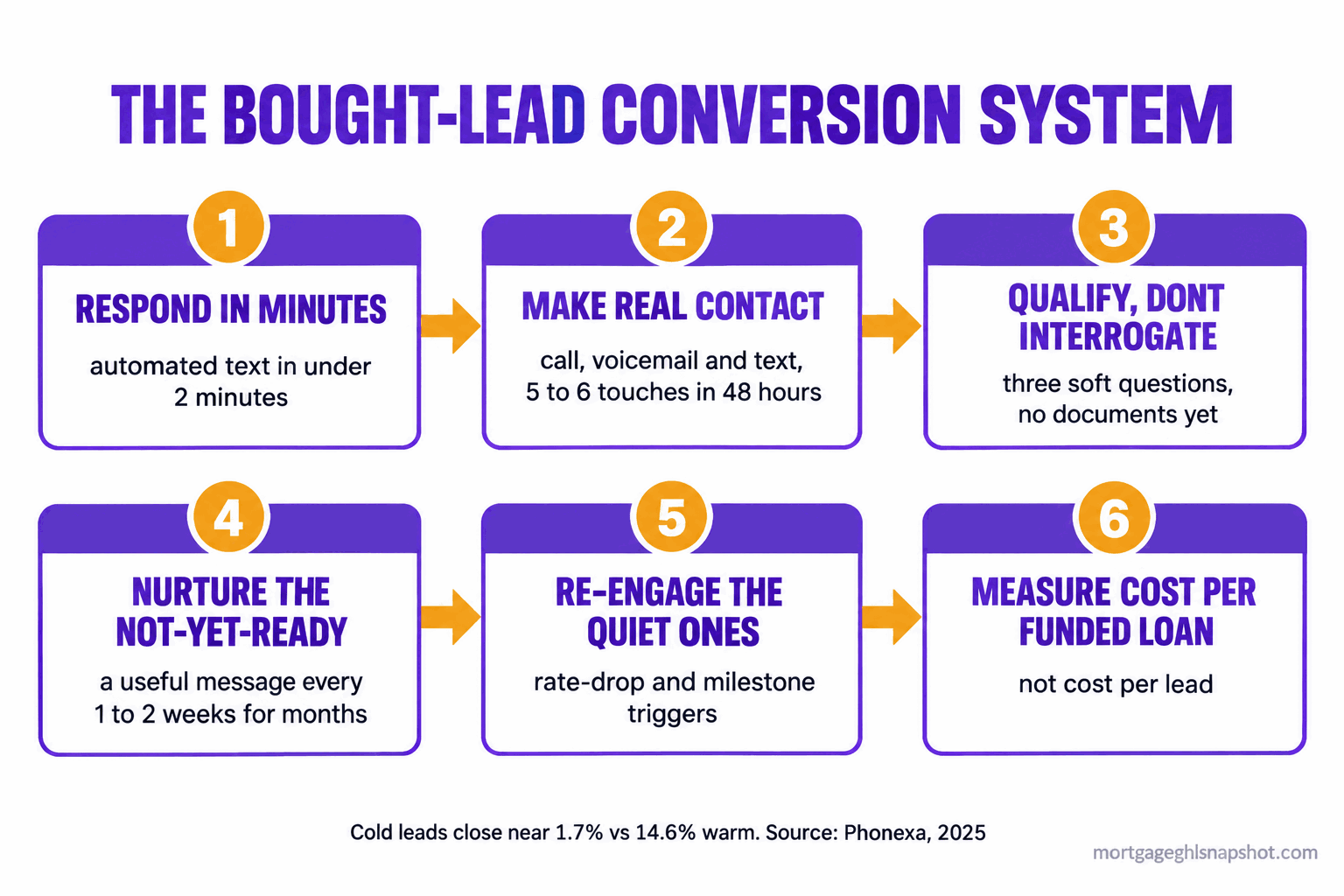
Now the conversion math. Cold leads close at roughly 1.7%, while warm, relationship-driven prospects close near 14.6% (Phonexa, 2025). A bought lead starts at the cold end by definition: the borrower does not know you and handed the same form to several competitors. That 1.7% is the base rate for anyone who treats a cold lead like a warm one.
Close rates and lead costs are vendor estimates. Sources: Phonexa (2025); shared-lead distribution per LendingTree.
The real killer is time spent badly. Bought leads are expensive not because of the price per lead but because most LOs run them through a process that guarantees a 1.7% outcome, then pay for it again next week. The system below moves leads from cold to warm, the only move that changes the math. If you would rather not buy strangers at all, harvesting referrals from past clients is cheaper and closes far better, and most shops should do both.
Close rate by lead temperature, in percent. A follow-up system exists to move a bought lead from the left bar toward the right. Source: Phonexa (2025), citing Salesblink.
Why bought leads go quiet (four real reasons)
Before the fix, be honest about the diagnosis. A bought lead goes dark for four reasons, and only the rare one is actually “bad lead.”
- It was shared. Marketplaces like LendingTree send one inquiry to several lenders so the borrower can compare (LendingTree). They are not ignoring you; they already talked to whoever called first.
- You were slow. Firms that reach a web lead within an hour are about 7 times likelier to have a qualifying conversation than those who wait one more hour, and 60 times likelier than those who wait a day (HBR, 2011). A lead you call Tuesday that came in Monday is, statistically, already gone.
- You gave up too early. Most officers call twice, send one text, and quit, but a buyer who filled out a rate form is often three to six months out, so a follow-up that ends on day three abandons the lead right before it was ready.
- You interrogated them. A borrower who wanted a ballpark got asked for their Social on the first call. Shared leads are skittish; push too hard, too early, and they ghost. (The rare junk lead happens too, but with no system you cannot tell it from a good one you mishandled, so you blame the whole batch.)
The six-stage conversion system
Converting a bought lead is not about being a better salesperson. It is six jobs done in a fixed order, most of which should run automatically so they do not die the first busy week: (1) respond in minutes, (2) make real contact, (3) qualify without interrogating, (4) nurture the not-yet-ready, (5) re-engage the quiet ones, and (6) measure cost per funded loan.
The stages, with setup, failure modes, and copy
Stage 1: Respond in minutes, not hours
Setup. The moment a lead lands, an automated text should already be on its way, because you will not always be at your desk. Wire your lead source into your CRM so a new lead triggers an instant text and a task to call. The speed-to-lead math rewards the fast, and a missed-call text-back covers the calls you miss.
How it breaks. You rely on willpower. You mean to call every lead in five minutes, until you are in a closing, at lunch, or asleep. Automate the first touch so response time is not a function of your calendar.
Stage 2: Make real contact
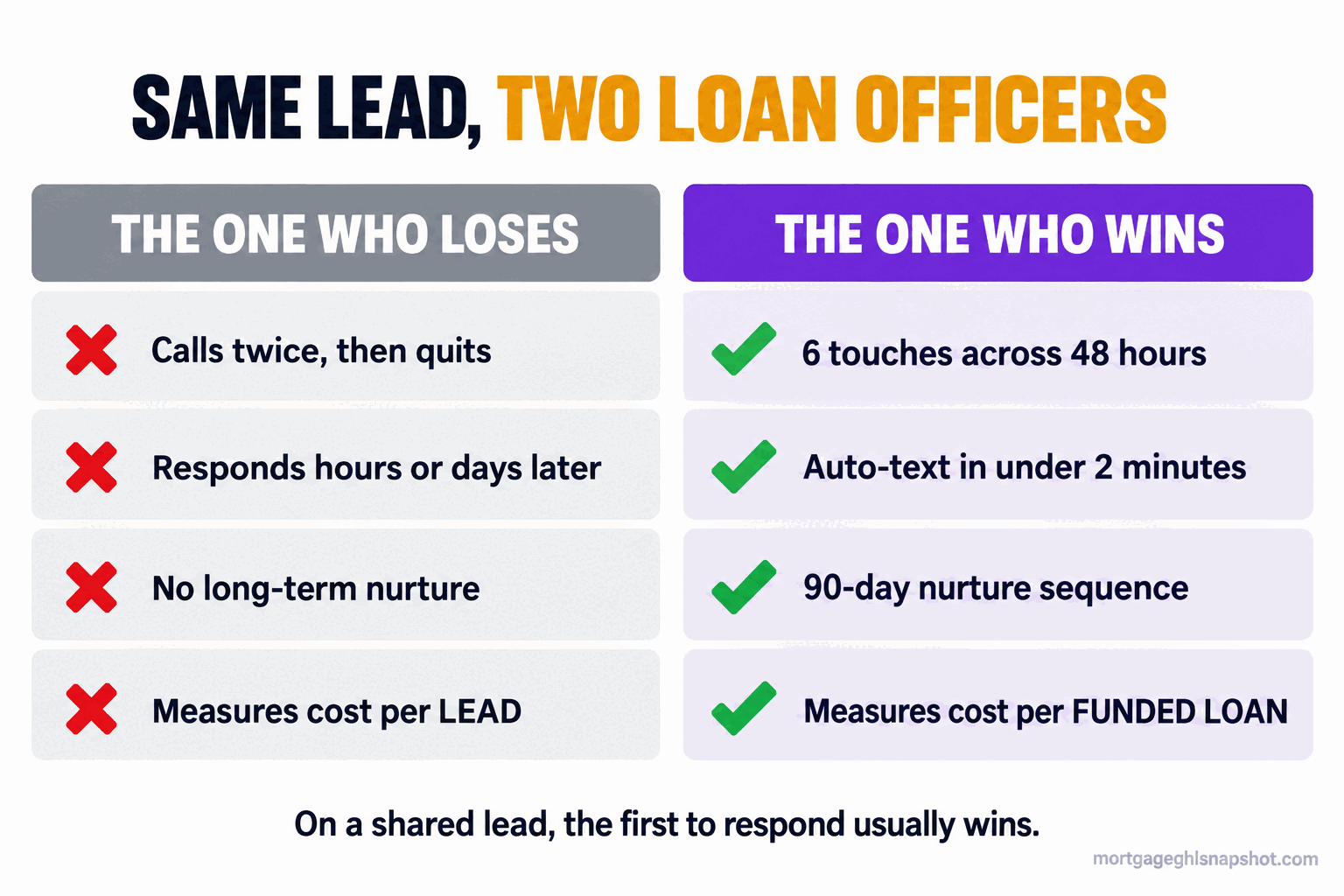
Setup. A text starts the conversation, but a shared lead usually needs a voice to win it. Day one gets a deliberate sequence: call within minutes, leave a short voicemail, then text referencing it. Five or six touch attempts across the first 48 hours is normal, not pushy, because you are racing four other officers doing the same thing.
How it breaks. You leave one voicemail, hear nothing, and file the lead under “didn’t answer.” The officer who closes this borrower is the one still showing up on attempt four when everyone else quit on attempt one.
Stage 3: Qualify without interrogating
Setup. Once you have a live human, your only early job is to sort them: ready now, ready soon, or not real. You do not need a full application, just three soft questions (the script is below). A light 1003-lite intake runs the rest in the background. Give a ballpark, set a next step, stop.
How it breaks. You treat the first call like underwriting, demanding pay stubs and a credit pull before the borrower trusts you with their email. On a shared lead that is fatal. Lead with a number and a next step; earn the documents later.
Stage 4: Nurture the not-yet-ready
Setup. Most of a bought batch is not buying this week. That is the shape of internet leads, and where the money hides. A borrower four months out is worthless to the officer who quits after two dials, and valuable to the one who stays in front of them. Build a long nurture: a useful message every week or two, dropping to monthly, mixing a market note, a calculator link, and a plain “still thinking about it?” check-in. Same muscle as a good pre-qualification follow-up sequence, pointed at colder traffic and run longer.
How it breaks. You have two modes: hammer them for a week, then silence. The borrower who was six weeks out buys in the spring and closes with whoever stayed in touch. Automate the nurture and let it run for months, because this is where bought leads actually pay off.
Stage 5: Re-engage the quiet ones
Setup. Leads that went dark are not dead, they are dormant, and a good trigger wakes them. When rates move, every quiet borrower should get a reason to call back. A rate-drop alert that says their payment just got cheaper restarts conversations you thought were over, as does a seasonal nudge or a simple re-permission text. The lead you paid for in March can close in September if you never fully let go.
How it breaks. You purge “dead” leads and delete the exact people who were going to buy two quarters later. Or you blast a rate-drop to everyone without checking who it fits, so a borrower who just locked gets told to refinance. Segment by loan type and stage so every trigger is true.
Stage 6: Measure cost per funded loan
Setup. Stop measuring cost per lead; it is why you keep buying. What matters is cost per funded loan: total spent on a source divided by the loans it closed. Tag every lead with its source in your CRM, follow it to funding or dead, and total it by vendor each quarter. One source might cost $60 a lead and never fund, another $120 and close one in twenty. The cheap one is the expensive one.
How it breaks. You judge a source on how the leads feel in week one instead of what they funded in month six, which favors the vendor with the friendliest rep. A CRM built for loan officers makes this a report instead of a spreadsheet you never update.
Solo LO, a five-person team, and a fifteen-LO shop
The six stages are the same at every size. What changes is how much runs on you and how much runs on a system.
The solo LO buying ten leads a month. You are the bottleneck, which is fine if you remove yourself from the time-sensitive parts. Automate stages one, four, and five completely, the ones that cannot wait for you to be awake. Spend your human hours on the calls and qualifying, because your edge over a loan factory is that you can personally out-care it.
The small brokerage with five LOs. Your risk is inconsistency: one officer runs a tight day-one sequence, another lets leads sit until lunch, so cost per funded loan becomes a coin flip. Standardize it. Every lead enters the same automated first touch and nurture regardless of owner, routing is instant and round-robin, and you review cost per funded loan by source and officer monthly.
The fifteen-LO shop spending real money on leads. Lead spend here is a line item big enough to audit. Route by availability so the fastest responder gets first crack, score sources quarterly and cut the ones that do not fund, and run a dedicated long-term track for leads nobody closed in 30 days. A shop this size wasting even 20% of lead spend leaves tens of thousands on the table a year.
Buying and texting leads without a TCPA problem
This is where loan officers get nervous, and the ground genuinely shifted recently, so here is the current picture in plain terms. None of this is legal advice, and you should run your setup past counsel.
The one-to-one consent rule is gone. In late 2023 the FCC adopted a “one-to-one consent” rule that would have required a consumer to consent to each company separately, gutting the shared-lead model marketplaces run on. It never took effect: the Eleventh Circuit vacated it on January 24, 2025 in Insurance Marketing Coalition v. FCC (Wiley, 2025), and the FCC formally eliminated it in a 2025 final rule (Consumer Finance Insights, 2025). The upshot: buying and contacting shared leads is not blocked by that rule.
But the TCPA itself did not change. You still need prior express consent to send marketing texts or autodialed calls to a borrower’s cell, you must honor an opt-out immediately, and do-not-call rules still apply (FCC). On a bought lead that consent comes from the form the borrower filled out, so buy only from vendors who pass real consent records and keep them. If a vendor cannot show you the consent language and timestamp, that exposure is yours, not theirs.
Register your texting and put your NMLS ID on it. Business texting runs through A2P 10DLC registration or your messages quietly fail to deliver, which kills your speed-to-lead. Add your NMLS ID to messages that count as advertising under the SAFE Act, honor STOP on the first request, and never quote a rate you cannot deliver, which keeps you clear of UDAAP trouble. Good automation logs consent, opt-outs, and the paper trail for you instead of leaving it to memory.
The objections I hear every week
“Portal leads are just bad. I’ve tried them.” Some are. But “I called twice and nobody answered” is not a test of lead quality, it is a test of your follow-up, and it fails almost everyone. Run one batch through the full system, then judge it on cost per funded loan. Either the source was fine and your process was the problem, or you now have hard proof to cancel the vendor.
“I don’t have time to call a lead six times and nurture it for months.” Right, which is why almost none of this should be you. The instant text, the nurture, the rate-drop triggers, and the source tracking all run on their own. Your human time goes to the live calls and qualifying, which a machine cannot do well.
“Isn’t instant texting a stranger kind of spammy?” The opposite, when it is fast, relevant, and asked for. The borrower submitted a form 90 seconds ago asking for exactly this. Fast and specific reads as good service.
Go back to that Monday morning and the $600 wire. The leads in that batch are not the problem. One is probably ready to buy in the next six months, two more within the year, and the officer who closes all three is the one whose system answers in two minutes, calls six times, nurtures for ninety days, and remembers them when rates move. Build it once and the batch you bought this week finally earns back what you paid.
Frequently asked questions
Why don't my bought mortgage leads ever close?
Usually because of what happens in the first hour, not the quality of the lead. Marketplace leads are shared with four or five lenders at once, so the first to respond tends to win, and most officers call twice and quit before the borrower, often months from buying, is ready. Firms that contact a web lead within an hour are about 7 times likelier to have a qualifying conversation than those who wait one more hour. Fix speed and persistence and the same leads start closing.
How fast do I need to respond to a purchased mortgage lead?
Within minutes, ideally under five, which realistically only happens if an automated text fires the instant the lead lands. You cannot be at your desk every minute, so automate the first touch, then follow with a real call as fast as you can. On a shared lead, whoever responds first usually controls the conversation.
Is it legal to buy and text shared mortgage leads under the TCPA?
Yes. The FCC's one-to-one consent rule, which would have restricted shared-lead contact, was vacated by the Eleventh Circuit in January 2025 and formally removed later that year. But the core TCPA rules still apply: you need prior express consent to text or autodial a cell, you must honor opt-outs immediately, and do-not-call rules stand. Keep the consent record from each lead's form, and buy only from vendors who pass it. This is not legal advice.
How many times should I follow up with an internet mortgage lead?
More than you think. Plan for five or six touch attempts across the first 48 hours, a mix of calls, a voicemail, and texts, then a long nurture of a message every week or two for months. A buyer who filled out a rate form is frequently three to six months from a purchase, so follow-up that ends on day three throws away most of what you paid for.
Should I buy exclusive or shared mortgage leads?
Shared leads are cheaper but you compete with several lenders, so they reward speed and a tight follow-up system. Exclusive leads cost more because nobody else gets them, which buys time but not a close. Either way the deciding factor is your process: a fast, persistent system makes shared leads profitable, while a slow one wastes exclusive leads too.
Are bought leads better than referrals for a loan officer?
No. Referrals are cheaper and close far better, around 14.6% for warm leads versus 1.7% for cold ones. But referrals compound slowly, so bought leads can fill the pipeline now if you run them through a real conversion system. For most shops the answer is both: referrals as the foundation, bought leads as a dial you turn up once your follow-up works.