It is the Monday before Thanksgiving. Your pipeline finally looks healthy, three deals clear to close, when a red banner shows up in your NMLS account: your renewal is not filed and your continuing education is not done. You have not thought about CE since last December. Now you have five weeks, a holiday in the middle of them, and a license that turns into a pumpkin at 11:59pm on December 31 if you get this wrong.
Here is the short version. State-licensed loan officers renew through the Nationwide Multistate Licensing System every year between November 1 and December 31, and you cannot renew until you finish 8 hours of NMLS-approved continuing education for the year. Miss December 31 and your license expires January 1. This guide lays out the exact calendar, the 8 hours you owe, the rules that change the moment you cross a state line, and the checklist that keeps this from ever being a fire drill again.
The 2026 renewal calendar, date by date
Renewal is not a single deadline. It is a season with four dates that matter, and most originators only remember the last one. Put all four on your calendar and it gets boring, which is what a licensing task should be.
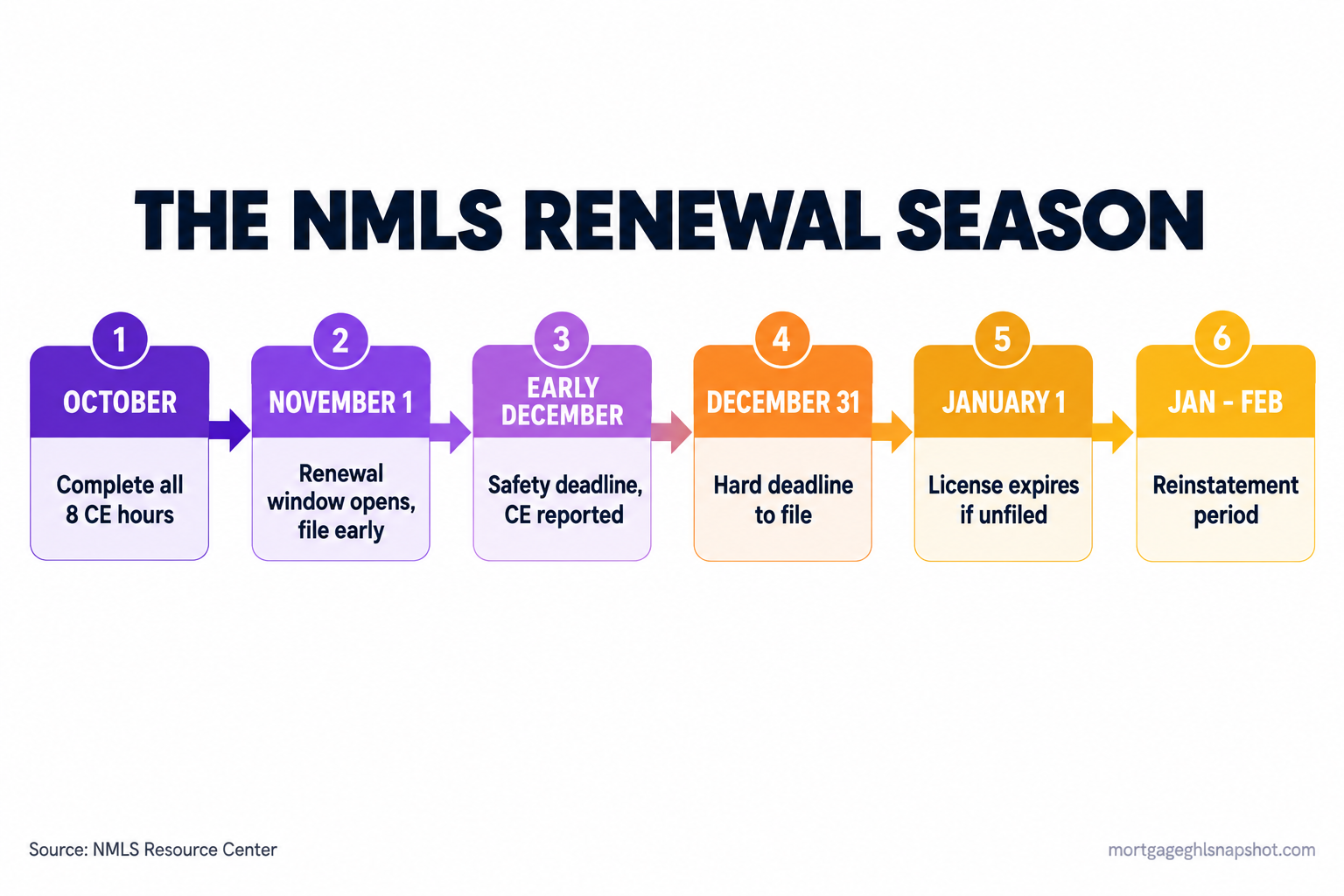
November 1 to December 31: the renewal window. This is when the renewal request itself lives in NMLS. You log in, attest to a set of questions, authorize a fresh credit pull if your state requires one, and pay the fees. The window is the same nationwide (NMLS Resource Center).
The early-December CE cutoff. Your CE has to be reported into NMLS before your renewal can process, and providers can take up to seven days to report a completion. That is why the system pushes a recommended deadline in early December rather than New Year’s Eve. Finishing the week of December 5 gives the provider time to report and you time to fix a problem (The CE Shop).
December 31: the hard deadline. If your renewal request is not submitted and paid by 11:59pm on December 31, your license endorsement expires. There is no grace period. At midnight you are no longer authorized to originate.
January 1 to the end of February: reinstatement. Most states let you still renew a lapsed license in the first two months of the year, for a higher fee and only after your late CE is complete (The CE Shop). Blow past reinstatement and you file a brand-new application. Let a license sit lapsed long enough and you can be forced to retake the full 20 hours of pre-licensing education.
What a lapsed license actually costs you
A lapsed license is not a paperwork inconvenience. The day it lapses, you cannot legally originate a loan. Every application in your pipeline that has not funded is stranded, because you are not authorized to work it. Your co-workers absorb your deals or your borrowers walk, and the realtor who sent them watches it happen. Referrals are the game, and a blown closing is the fastest way to lose one.
That matters because of who feeds your pipeline. In the 2025 NAR Profile of Home Buyers and Sellers, 88% of buyers purchased through an agent or broker, and 66% of sellers found their agent by referral or repeat business. A license that lapses in January, right as the spring market is being set up, costs you the agent relationships that would have fed you all year, not just the deals in front of you. And you are renewing alongside 221,161 producing loan officers (HousingWire, 2025) filing in the same window, so providers and support lines get slammed at year end. Early is how you skip the bottleneck.
Total annual continuing-education hours required to renew, by state. Most states follow the federal 8-hour minimum; a handful require more. Sources: 12 CFR 1008, California DRE, Texas SML, The CE Shop.
There is a direct out-of-pocket cost too. The flat NMLS processing fee rose to $35 per individual on March 1, 2025 (CSBS, 2025). That $35 is only the system fee. On top of it you pay your state’s own renewal fee (which varies widely), a credit-report and background-check fee where re-run, and the CE course. Multi-state originators pay each state’s fee every year, and reinstatement costs more. The expensive part, though, is the pipeline you cannot touch while your license is dark, including the past-client database you should be reactivating.
The 8 hours every MLO owes
The SAFE Act sets the floor: every state-licensed originator must complete 8 hours of NMLS-approved CE each year to renew, and the content is fixed by federal rule (12 CFR 1008.107):
- 3 hours of federal law and regulations. TRID, RESPA, ECOA, the SAFE Act itself.
- 2 hours of ethics, which by rule includes fraud, consumer protection, and fair lending.
- 2 hours of non-traditional mortgage product lending, the standards beyond a plain 30-year fixed.
- 1 elective hour, which in a lot of states becomes a state-specific hour (more below).
These 8 are the same whether you closed 4 loans or 400. A few details trip people up:
The successive years rule. You cannot take the same approved CE course in two consecutive years. NMLS reads “successive years” as back to back, and if you retake last year’s exact course, the hours will not post to your record, which can leave you ineligible to renew (NMLS). This is how people get caught out: they buy the same convenient bundle, finish it December 20, and find out December 27 that the hours did not count. Look at what you took last year and pick something different, every year.
Late CE. If you did not finish your hours and your license lapses, most states make you complete “late CE” for the year you missed before you can reinstate, on top of the current year’s hours. Miss two years and you can owe two years of CE. A lapse does not mean “renew later.” It means renew later plus make up the education you skipped, at a higher fee, with your license dark the whole time. Eight hours is one focused day in October; the originators who never sweat renewal knock it out then and forget about it.
The rules that change by state line
This is where a national checklist stops being enough. The 8-hour federal floor is universal, but states layer their own requirements on top, and those differences are exactly what quietly disqualifies a renewal.
California. Licensed under the California DFPI, 1 of your 8 hours must be California-specific law (the Finance Lenders Law, the Residential Mortgage Lending Act, the Homeowner Bill of Rights). California is also stricter on advertising: a broker licensed through the DRE has to show the real estate broker license number in addition to the NMLS identifier on ads run in the state, where most states want only the NMLS ID.
Texas. The Texas Department of Savings and Mortgage Lending requires the plain federal 8 hours with no state-specific education. But it is demanding about advertising: an ad must show the company name and NMLS ID plus the sponsored originator’s name and NMLS ID, unburied by shading or graphics, with social media satisfied at the profile level (7 TAC 56.203).
New Jersey requires 12 hours, not 8. Several other states require the elective hour to be state-specific, including Florida, New York, Georgia, North Carolina, and Washington (The CE Shop). If you are licensed in more than one state, you owe the highest requirement across all of them, and the state-specific pieces for each.
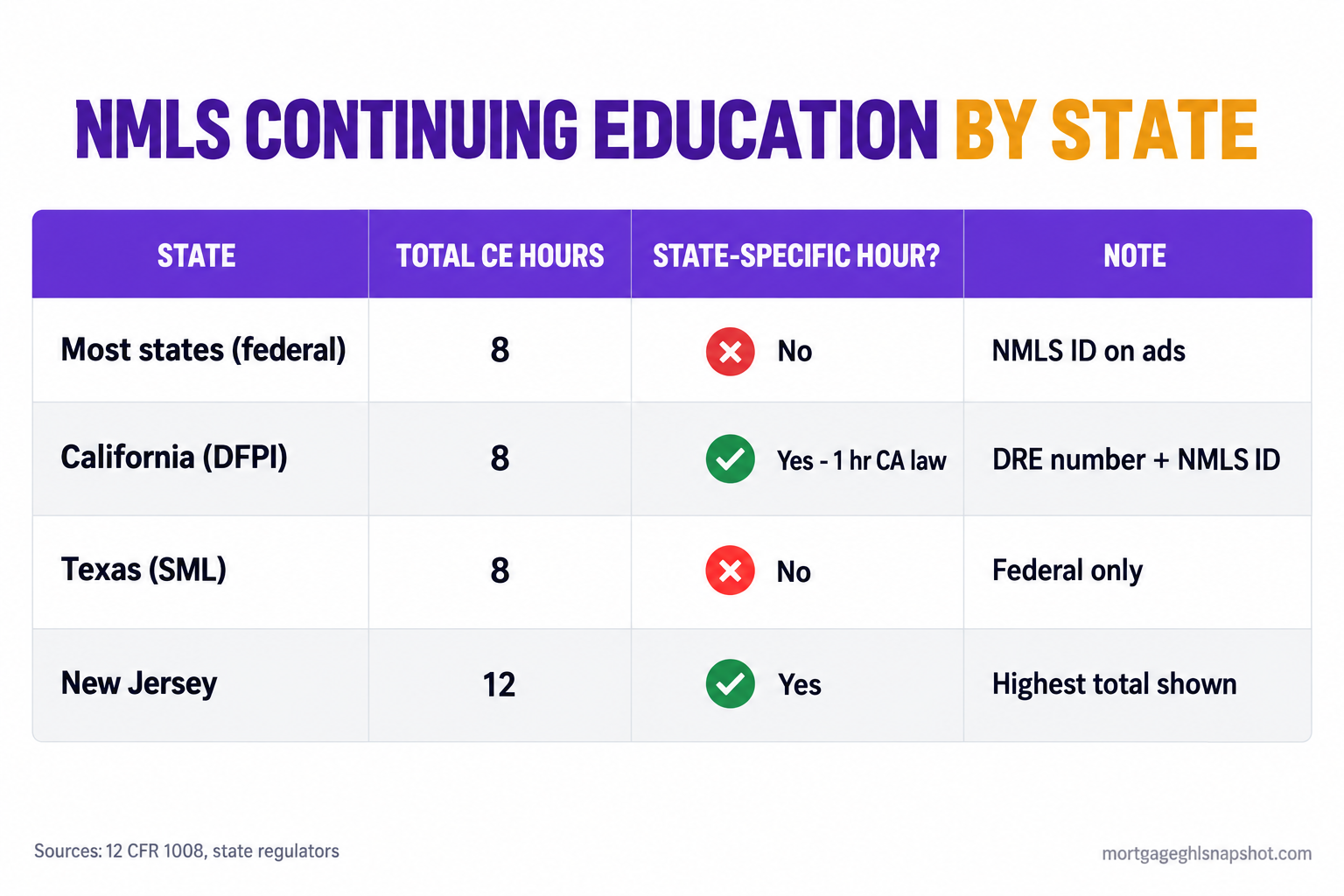
Here is a starting table for the states that trip originators up most. Always confirm against your state’s current checklist in NMLS before you register, because states adjust these.
| State | Total CE hours | State-specific hour? | Notable advertising rule |
|---|---|---|---|
| Federal baseline (most states) | 8 | No | NMLS ID on advertising |
| California (DFPI) | 8 | Yes, 1 hour CA law | DRE license number and NMLS ID |
| Texas (SML) | 8 | No | Company + originator name and NMLS IDs, unshaded |
| Florida | 8 | Yes, state elective | NMLS ID on advertising |
| New York | 8 | Yes, state elective | NMLS ID on advertising |
| New Jersey | 12 | Yes, state elective | NMLS ID on advertising |
Confirm current requirements against your state regulator’s checklist in NMLS. Sources: California DRE, Texas SML, The CE Shop, NMLS CE requirements.
The point is not to memorize all fifty. It is to read your own state’s checklist once a year, and build to the strictest state you hold if you carry more than one.
The renewal itself, step by step
Once your CE is posted, the renewal request is short, but it still has a few places people stumble.
Confirm your CE posted before you file. Check that all 8 hours (or your state’s total) show as complete and reported in NMLS. Do not trust the provider’s confirmation email; the credits have to appear on your record, and there is a lag. Filing against an incomplete education record is the most common self-inflicted delay.
Answer the disclosure questions honestly. Renewal makes you attest to questions about criminal, civil, and regulatory history. A new charge, judgment, or lien has to be disclosed. Answering on autopilot the way you did last year, and missing something new, is a misrepresentation on a licensing filing, which is its own violation.
Pay every fee, for every state. Authorize a fresh credit pull if your state re-runs one, then pay the NMLS fee and each state renewal fee you owe. A single unpaid state does not renew even when the others do. After submitting, verify each license reads renewed and save the confirmation.
Solo LO, multi-state LO, and a team
The rules are the same at every size. The workload and the failure points are not.
The solo loan officer. One or two licenses, and you are the only person who will ever remember to do this. Your risk is simple neglect: a busy fourth quarter, and renewal falls off the radar until a red banner appears. Block one day in October for all 8 hours, set two reminders (CE and filing), and file in early November instead of late December.
The multi-state originator. Licensed in three, five, ten states, each with its own hour total, state-specific requirement, and fee. Your risk is a gap you do not see: you cover the federal 8, forget New Jersey wants 12, and one state quietly lapses. Build a per-state matrix once, satisfy the strictest state, and reconcile every license after you file.
The small brokerage with a team. Now you have 2 to 15 originators, and one lapsed license is a hole in the whole shop’s capacity plus a supervision question for you. Your risk is assuming everyone handled their own. They did not. You need a shared tracker with every LO’s CE and renewal status, a hard internal deadline of early December, and one person who owns the follow-up. A CRM that already runs your pipeline can hold that tracker and fire the reminders, the same way you treat keeping your texting compliant.
Keep your NMLS ID current on every ad
Renewal is not only about the right to originate. It keeps your NMLS unique identifier valid, and that identifier is load-bearing for your marketing. The SAFE Act requires you to provide your NMLS ID to consumers, and state rules require it on advertising (12 CFR 1008). If your license lapses, the identifier on your postcards, your Facebook ads, and your website points to a status that no longer authorizes you: an advertising problem stacked on the licensing one.
So confirm your NMLS ID shows correctly everywhere you market, building to the strictest state you hold (California wants the DRE number too, Texas wants the company and originator identifiers shown cleanly). It is the same discipline that keeps your realtor co-marketing on the right side of RESPA: the details you can document are the details that protect you.
Steal this: the renewal checklist and calendar
This is the part to bookmark. None of it is legal advice, and confirm specifics against your own state’s checklist, but these are the building blocks that make renewal a non-event.
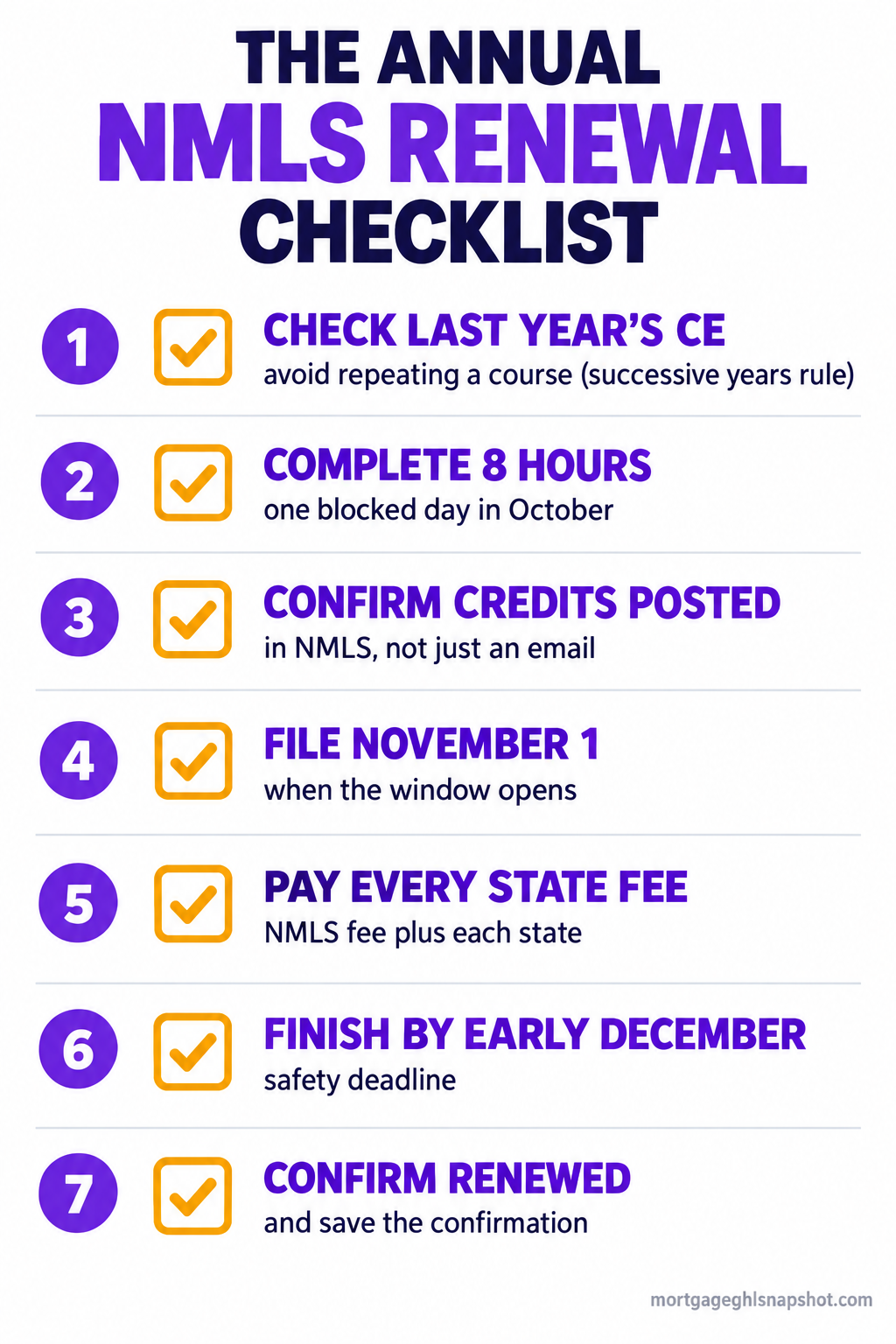
Write these into your systems once and renewal stops being an annual scramble. The originators who never lapse are not more organized by nature. They just moved the work to October and let a checklist carry it.
The objections I hear every fall
“I’ll just do it December 30, I always do.” You have been lucky. The failure modes that end careers, a successive-years course that does not count, a provider reporting lag, a failed CE exam, all need days to fix, and December 30 does not have days left. Being early costs one afternoon in October. Being late costs a dark license in January.
“My license lapsed once and nothing bad happened.” Something bad happened, you just did not see the invoice. Every day a license is lapsed is a day you cannot originate. If you had no clear-to-close deals in that window, you got lucky on timing. Do not build a career on it.
“I’m licensed in one state, this is overkill.” One state is the easiest case, which is exactly why one-state originators get complacent and lapse. The checklist is shorter for you, not optional.
“Can’t my company handle my renewal for me?” It can help and remind, but the renewal request, the attestations, and the CE are tied to you as the individual originator. If it lapses, it is your name and your license, not the company’s. Own it.
Back to that Monday before Thanksgiving. Block a day in October and that red banner never shows up: the deals close, the agent sends three more, and renewal is a thirty-minute task you finish over coffee. The license is the license to do the job. Protect it like the asset it is.
Frequently asked questions
When is the NMLS renewal period for 2026?
The NMLS annual renewal window runs from November 1 to December 31. You submit your renewal request and pay all fees within that window, and your continuing education must be completed and reported first. Miss December 31 and your license endorsement expires on January 1.
How many hours of continuing education do I need to renew?
Under the SAFE Act, every state-licensed loan originator needs 8 hours of NMLS-approved CE each year: 3 hours federal law, 2 ethics, 2 non-traditional mortgage lending, and 1 elective. Some states require more (New Jersey requires 12), and some require the elective hour to be state-specific (12 CFR 1008.107).
What happens if my NMLS license lapses on January 1?
You are no longer authorized to originate, so your pipeline cannot be worked. Most states offer a reinstatement period from January 1 through the end of February, at a higher fee and only after you complete late CE. Miss reinstatement and you file a new application entirely.
Can I take the same CE course two years in a row?
No. The SAFE Act's successive years rule prohibits taking the same approved course in two consecutive years. If you do, the hours will not post to your record and your license may be ineligible for renewal. Check last year's courses before you register.
Do continuing education requirements differ by state?
Yes. The federal 8-hour minimum is universal, but states add to it. California DFPI requires 1 hour of California law, Texas requires the plain federal 8, and New Jersey requires 12. If you are licensed in multiple states, satisfy the highest requirement plus each state's specific pieces.
How much does NMLS renewal cost?
The flat NMLS processing fee is $35 per individual as of March 1, 2025 (up from $30). On top of that you pay your state's own renewal fee, which varies widely, plus a credit-report and background-check fee where re-run, plus the CE course. Multi-state originators pay each state's fee every year, and reinstatement costs more.