
It is the first week of a new quarter and your pipeline is thin. So you do what you always do when it gets quiet: open the lead vendor’s site and buy another batch of internet leads at sixty bucks a pop, knowing most will never answer. Meanwhile your CRM is full of people who already trusted you with the biggest loan of their life. They closed, they were happy, and then you never spoke again. You are renting strangers while your best asset gathers dust.
Here is the uncomfortable math. Most of your business already comes from referrals and repeat clients, not leads you bought. You just are not harvesting it on purpose. This guide is the system I set up for loan officers tired of paying for cold traffic: a six-stage referral engine that turns a closed loan into the next three, mostly on autopilot. You get the stages, the scripts, the timing, and the compliance lines that keep it legal.
What buying leads instead of harvesting referrals costs you
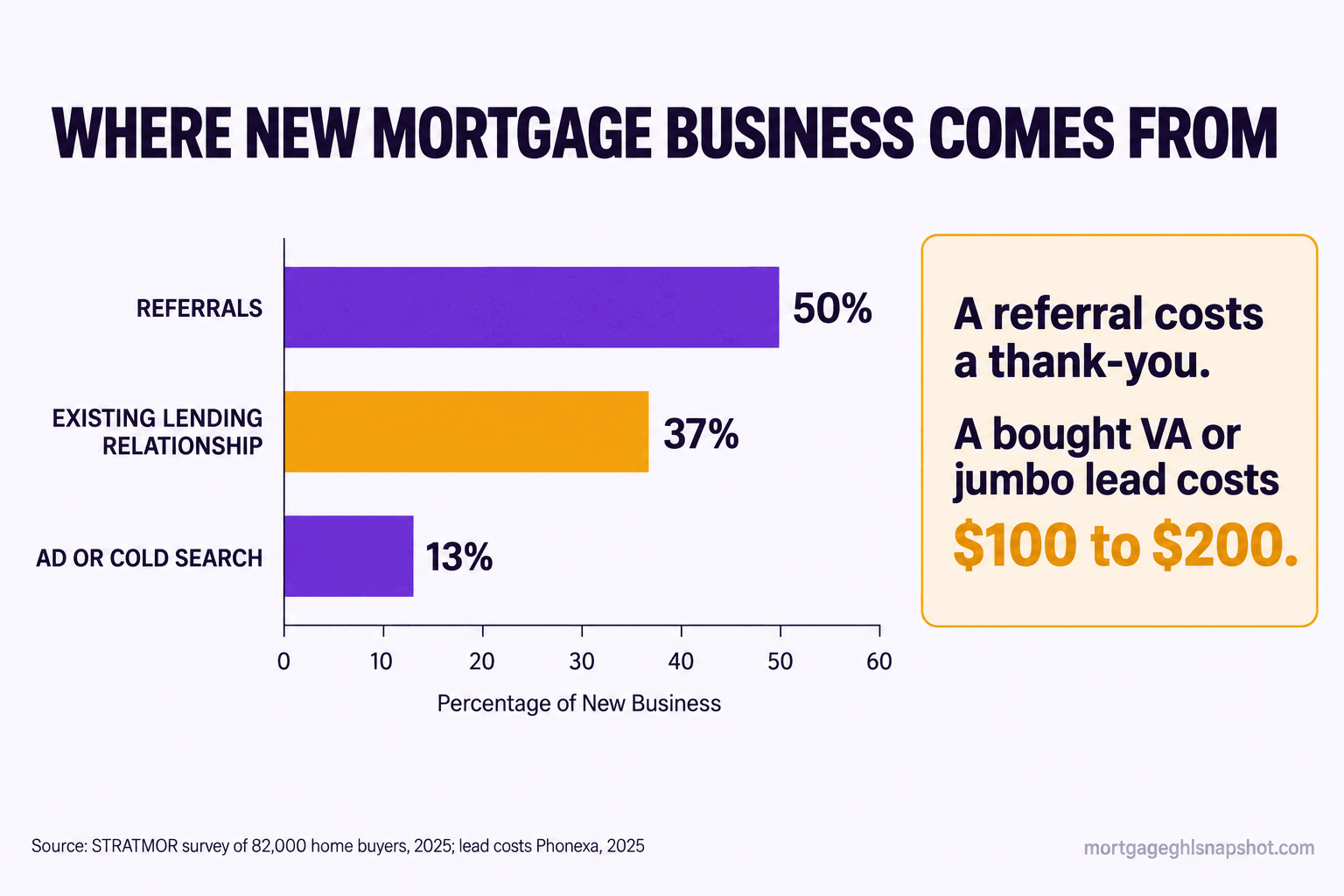
Start with where loans actually come from. STRATMOR surveyed 82,000 recent home buyers about how they picked their lender, and 87% named a person-to-person relationship: 50% from a referral and 37% from an existing lending relationship, a polite way of saying a past client who came back (STRATMOR via Inman, 2025). Only a thin slice found their lender through an ad or cold search.
Now price the alternative. When you buy leads, you pay for the slice of the market that did not already trust someone. A conventional or FHA internet lead runs roughly $20 to $100, a VA lead $50 to $150, and a jumbo lead $100 to $200, before you count how few ever answer (Phonexa, 2025). Warm, referred prospects close near 14.6% while cold leads close near 1.7% (Phonexa, 2025). The referral is cheaper and roughly eight times likelier to fund.
How recent home buyers chose their lender, from a survey of 82,000 borrowers. Source: STRATMOR via Inman (2025).
The real estate side tells the same story: in the 2025 NAR Profile of Home Buyers and Sellers, 88% of buyers used an agent and 91% of sellers did, with referrals and repeat relationships driving most of how those agents get hired (NAR, 2025). Trust moves through people, and most LOs have no system to be in front of them when a loan comes up. They have a drawer full of closed files and a vague intention to “stay in touch” that never survives a busy month.
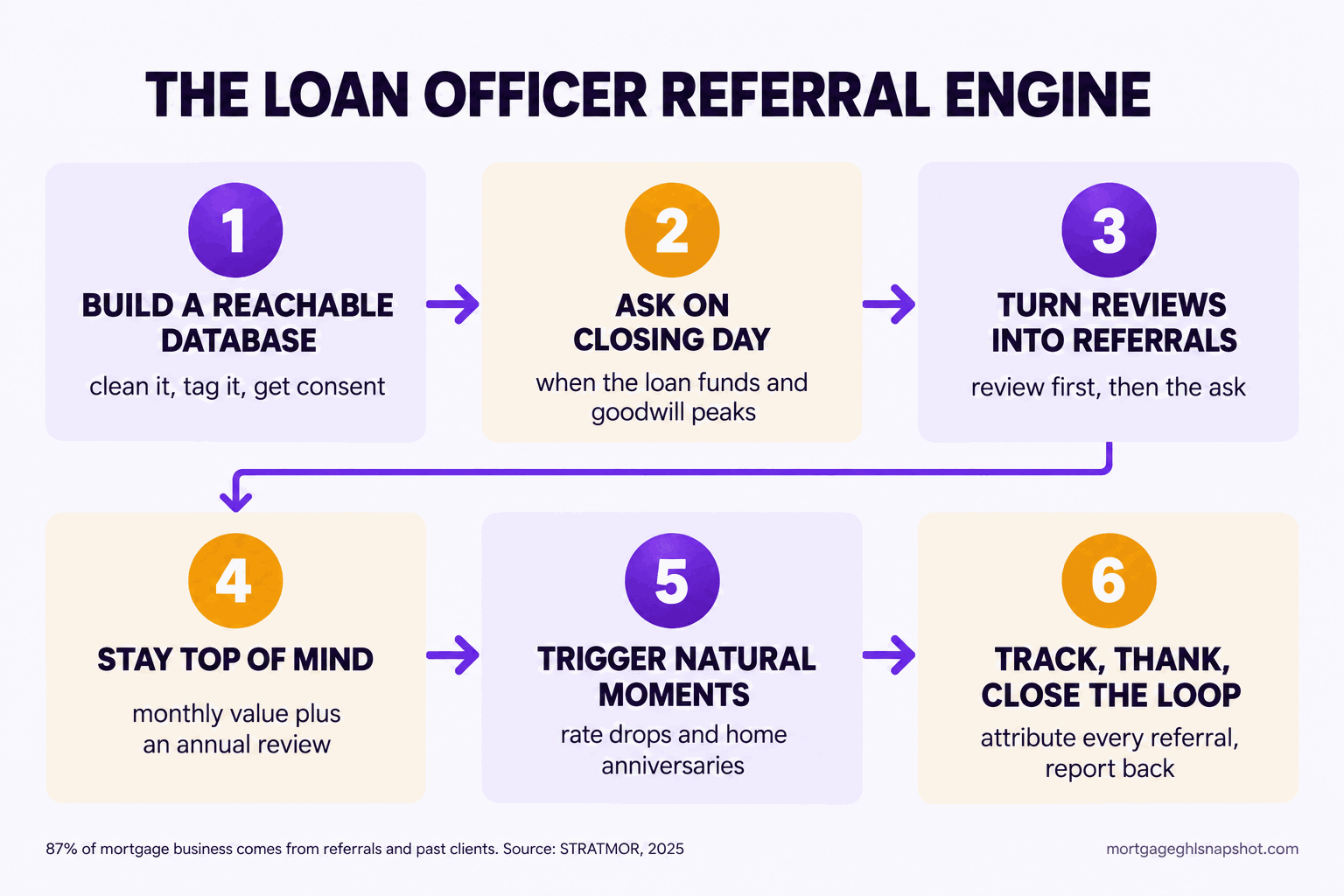
The six-stage referral engine, start to finish
A referral engine is not charisma. It is six jobs done on a schedule, most of which a CRM can run so they do not die the first busy week. Here is the whole system before we go deep:
- Build a database you can reach. Clean the list, tag it, get consent. No consent, no engine.
- Ask on closing day. The day the loan funds is your single best moment to earn a referral and a review.
- Turn reviews into referrals. A public review builds proof and primes the person to send you a name.
- Stay top of mind with a value cadence. People refer the LO they remember, so stay in the feed without being a pest.
- Trigger natural moments. Rate drops, anniversaries, and equity milestones give people a reason to mention you.
- Track, thank, and close the loop. Attribute every referral, thank fast, report the outcome. That is what makes a referrer refer again.
The stages, with setup, failure modes, and copy
Stage 1: Build a database you can actually reach
Setup. Export every past borrower and applicant into your CRM as real contact records, not a spreadsheet you forget exists. Tag each one by close date, loan type, referral source, and whether they own or still rent. Capture and record consent, because the engine runs on texting and emailing people and you need the paper trail. If the list is years old, send a re-permission message first. A tagged, consented database is the asset most LOs never touch, worth more than any lead list.
How it breaks. Two ways. You blast a stale list with no record of consent and trip over TCPA, which we cover below. Or the list is so neglected half the numbers bounce, so you decide “referrals don’t work” when really your database rotted. Clean first, then run.
Stage 2: Ask on closing day, when goodwill peaks
Setup. The warmest a client ever feels toward you is the day their loan funds and they get the keys, so that is when the ask should fire, not three months later when the glow has faded. Build a closing-day sequence: a congratulations text on funding day, a short review request two days later, and a soft referral ask about a week in. Make the ask specific. “Know anybody who needs a mortgage” gets a shrug. “If a friend mentions buying this spring, I’d love for you to send them my way” gets a name.
How it breaks. You wait too long, or you make it about you. A desperate “I’d really appreciate referrals, things are slow” turns a happy client cold. Lead with their win, keep the ask small and specific, and never attach it to a discount or gift that implies payment.
Stage 3: Turn reviews into referrals
Setup. Ask for the public review before the referral, because it does double duty. It builds the social proof that makes the next borrower trust you, and writing something nice primes the client to recommend you out loud. Automate the ask so every funded loan gets it, route it to your Google Business Profile, and make it one tap. Our Google reviews playbook covers the mechanics and cadence.
How it breaks. Three classic mistakes: asking everyone on the same day and drowning in follow-up; sending the public link only to people you know are happy, which is review gating and against Google’s policy; or offering a gift card for a review, which breaks the platform rules and drags you toward RESPA and UDAAP problems. Ask everyone, route the unhappy ones to a private reply first, and never pay for a star.
Stage 4: Stay top of mind with a value cadence
Setup. People refer the loan officer they remember, and memory fades fast. You need a light, useful touch on a schedule so you are already in mind when a friend mentions they are thinking about buying. A monthly or quarterly value email, plus an annual mortgage review that checks their rate, equity, and whether their loan still fits, keeps you present without begging. The annual review is the quiet workhorse: a real reason to reach out, it surfaces refis and cash-out deals, and it ends on a natural referral moment.
How it breaks. Two opposite failures. You go dark for eighteen months and reappear only when you need business, which reads as self-serving. Or you flood people with generic blasts nobody opens, so emails land in spam. The fix is cadence plus value: fewer sends, each one actually useful.
Stage 5: Trigger natural moments
Setup. The best referrals happen when a client has a fresh reason to talk about their mortgage, so manufacture those reasons. Set triggers for rate drops, purchase anniversaries, and equity milestones. A rate-drop alert that tells a past client they could save money gets forwarded to friends. A “happy one-year in the house” note lands warm. When you reach out to give, not to get, the referral follows. Keep your rate-drop callback scripts ready so the conversation goes somewhere.
How it breaks. You only reach out when you want something, so every message smells like a sales call. Or you fire a rate-drop blast without checking who it helps, and a client who refinanced last month gets told to refinance. Segment by loan type and date so the trigger is true for the person receiving it.
Acquisition cost per lead in dollars (midpoint of published ranges); a referral costs a thank-you. Source: Phonexa (2025). Illustrative of the cited ranges.
Stage 6: Track, thank, and close the loop
Setup. Every referral needs three things: attribution, a fast thank-you, and an outcome report. Record who sent each new borrower. The moment you know, thank them with a real message, not a form note. And when the loan closes, go back and tell them it worked out. That last step is the one almost everyone skips, and it is what makes a person refer you a second and third time, because now they know their recommendation paid off.
How it breaks. You never ask “who sent you,” so you have no idea which relationships produce and you spread your attention evenly instead of pouring it into the five people who send most of your business. Or you take the referral, close the loan, and go silent. Close the loop every time.
Solo LO, small team, and a referral-driven shop
The six stages are the same at every size. What changes is how much runs on you and how much runs on a system.
The solo loan officer. You do not need a thousand raving fans, you need twenty. Let the CRM fire the closing-day sequence, the review ask, and the cadence, and spend your own time on the personal layer: the handwritten note, the birthday call, the coffee with your five best referrers. Your edge over a big shop is that you can actually be personal.
The small brokerage with 2 to 15 LOs. Here the risk is inconsistency: one LO runs a tight cadence and another never follows up, so the firm’s reputation is a coin flip. Standardize it. Every closed loan triggers the same sequence regardless of which LO owned it, every past client gets the same annual review, and database hygiene is a shared rule, not a personal habit.
The referral-driven shop. If referrals are already most of your business, treat the engine as infrastructure. Score referrers by deals sent, build a VIP tier for the top handful, and watch referrals per closed loan every month. When that ratio dips, you have an early warning your cadence went stale, long before the pipeline shows it. Pair this with your realtor referral partnerships so both channels feed the same clean database.
Asking for referrals without breaking RESPA or TCPA
This is where loan officers get nervous, and it is half right. The rules are real, but they do not stop you from asking.
RESPA Section 8 and the consumer referral. Section 8 bans giving or accepting a fee, kickback, or thing of value for the referral of settlement-service business, with penalties up to a $10,000 fine and a year in prison per violation (CFPB, 12 CFR 1024.14). That rule is aimed at paying realtors, title companies, and other settlement providers. Asking a past client, a regular consumer, to refer a friend is a different thing, and simply asking is fine. The danger zone is paying consumers cash per referral or handing out gifts that look like payment. Many lenders ban referral gifts outright, and even a nominal thank-you can be a gray area. So ask freely, never tie a reward to a specific referral, and run any incentive past your compliance team first. For the settlement-provider side, read our RESPA-safe co-marketing guide.
TCPA, consent, and opt-outs. The engine runs on texts and emails, so consent is not optional. You need prior express consent to text or call a client’s cell and must honor STOP immediately (FCC), and your texting should be registered through A2P 10DLC so it delivers (mortgage text message compliance guide). Add your NMLS ID to anything that counts as advertising, keep CAN-SPAM unsubscribe links in emails (FTC), and never quote a rate you cannot honor, which keeps you clear of UDAAP trouble.
The objections I hear every week
“Asking for referrals feels needy and desperate.” It only feels that way when you lead with your need. “Things are slow, send me business” is needy. “It was a pleasure helping you, and if a friend ever needs a hand I’d be honored” is generous. Clients who had a good experience want to refer you. They just forget unless you give them the opening.
“I don’t have time to stay in touch with everyone.” That is why you automate stages two through five. The closing-day sequence, the review ask, the value email, and the rate-drop triggers all fire on their own. Your only manual job is the top layer: the personal thank-you and the handful of relationships worth a real call.
“My database is old and I feel weird reaching out after years of silence.” Open with honesty. The re-permission text in stage one exists for this. People are not offended that their loan officer got busy. A warm “I’m cleaning up my contacts, want to stay in touch?” reopens almost every door, and the ones who opt out were never going to refer you anyway.
Go back to that thin pipeline at the start of the quarter. Before you buy another batch of strangers, open your CRM and count the past clients who would happily send a friend if you simply asked. That list is your cheapest, highest-converting lead source, and it is already paid for. Build the engine once, let it run, and the next quarter does not start thin.
How do loan officers get more referrals?
By running a system instead of hoping. Ask on closing day when goodwill is highest, request a public review that primes the recommendation, stay in touch with a value cadence and an annual review, trigger outreach on rate drops and home anniversaries, and always thank the referrer. STRATMOR found 87% of mortgage business comes from referrals and past relationships, so the volume is already there.
When is the best time to ask a client for a referral?
About a week after the loan funds, once they are moved in and the experience is fresh. Send a congratulations message on funding day, a review request a couple of days later, and a specific, low-pressure referral ask around a week in. Asking months later, after the glow fades, converts far worse.
Can I pay a past client for referring a mortgage?
Be careful. RESPA Section 8 bans paying for the referral of settlement-service business and is aimed at realtors and title companies, but paying consumers cash per referral or giving gifts that look like payment can still create RESPA and UDAAP exposure. Asking a past client to refer a friend is fine. Tying a reward to a specific referral is not. Run any incentive past your compliance team first.
Do I need consent to text past clients for referrals?
Yes. Under the TCPA you need prior express consent to text or call a client's cell, you must honor opt-out requests immediately, and your business texting should be registered through A2P 10DLC so it delivers. Send a re-permission message to any contact you have not spoken to in a year, and keep a record of consent.
Are referrals really better than buying mortgage leads?
By a wide margin. Purchased internet leads run roughly $20 to $200 by loan type and close near 1.7%, while warm referred prospects close around 14.6%, per Phonexa's 2025 figures. A referral costs you a thank-you and converts about eight times better.
How do I get referrals from a cold database?
Start with a re-permission message that is honest about the silence and asks them to opt in. Clean out dead numbers, tag the rest by loan type and close date, then run the value cadence and annual review before you ask for a referral. Reactivating an old database is usually cheaper than a single month of bought leads.