You finally have an hour to shop for a real CRM. Someone in a Facebook group swears by Jungo, the mortgage CRM “built on Salesforce.” You open the pricing page, see a seat price that looks reasonable, and almost put in your card. Then a question stops you: if it runs on Salesforce, am I also paying Salesforce? You are. That second bill is the whole story.
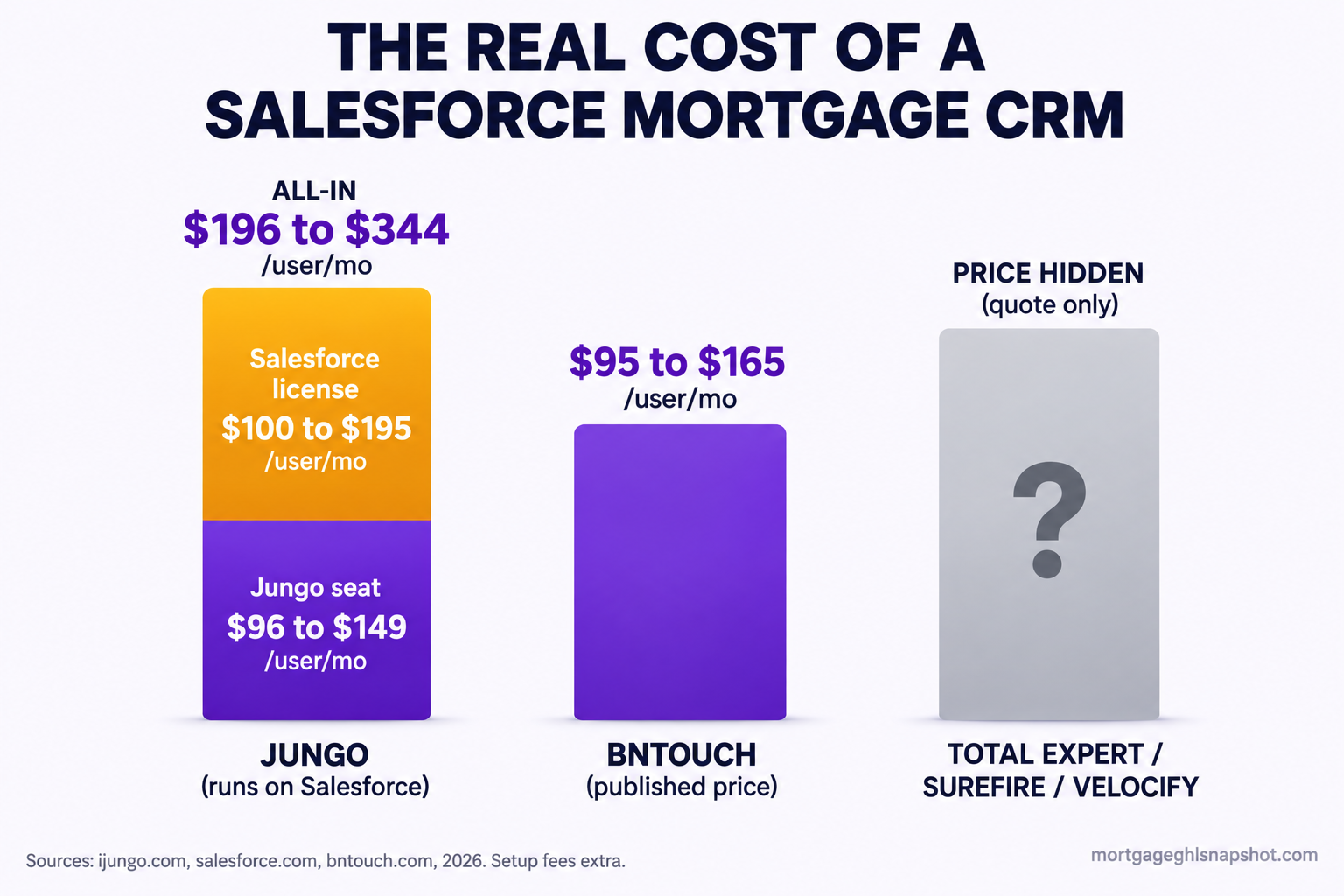
Here is the plain answer before you book a demo you do not have time for. Jungo’s own seat price runs about $96 to $149 per user per month depending on tier and billing (Jungo, 2026). But Jungo is a Salesforce-native app, so you also need a separate Salesforce license, billed by Salesforce at roughly $100 to $195 per user per month (Salesforce, 2026). Add them up and a single seat is closer to $196 to $344 a month, before a one-time $249 to $299 setup and a one-year minimum. Jungo’s page shows you the first number. This post is about the second.
What Jungo actually is (and the domain trap)
Jungo is a mortgage CRM built as a native app on top of Salesforce. Instead of being a standalone system, it installs into a Salesforce org and adds the mortgage layer: loan pipelines, borrower and partner records, 1003-style intake, task plans, co-marketing campaigns, and reporting on Salesforce’s engine. The pitch is simple: a purpose-built mortgage front end with the scale and integrations of the biggest CRM platform in the world.
Get one thing right before you even search: the real Jungo lives at ijungo.com. The domain jungo.com belongs to an unrelated telematics company and has nothing to do with mortgage software. For the mortgage CRM, ijungo.com is the only address that matters.
That Salesforce foundation shapes everything else, including the bill, and it is why the number on the pricing page is only half of what you will pay. The relationships this CRM protects are the whole business: 88% of home buyers still purchase through a real estate agent or broker, per the National Association of Realtors’ 2025 Profile of Home Buyers and Sellers (NAR, 2025). Pick the tool that keeps those relationships warm, not the one that looks cheap for a week.
What Jungo costs in 2026, tier by tier
Give Jungo credit for something the category mostly refuses to do: it publishes real prices (Jungo, 2026):
- Jungo Lite: about $96 per user per month billed annually (or $119 billed monthly), with a one-time setup of $249 on annual, $299 on monthly.
- Jungo Bundle: about $125 per user per month billed annually (or $149 billed monthly), with a $299 setup.
- Jungo Enterprise: “contact us,” no published number.
One note so a rep cannot anchor you: the widely repeated “$249 setup plus $119 a month” pairing mixes two tiers. The $249 setup goes with the $96 annual plan; $119 is the monthly rate. And every plan is an annual contract with a one-year minimum, so “cancel anytime” is not the deal.
On its own, $96 to $149 a seat is competitive, which is exactly why the sticker misleads. It is the price of the Jungo layer only, not of running Jungo.
The hidden line item: your Salesforce license
Because Jungo is a Salesforce-native app, your loan officers do not log into “Jungo.” They log into Salesforce, with Jungo installed inside it. So each user needs a Salesforce license, billed separately by Salesforce.
Salesforce repackaged its Sales Cloud editions in September 2026, so the old “Enterprise at $175” figure in older articles is stale. The current lineup runs from Pro Suite at $100 per user per month to Core at $195 per user per month for the editions a Jungo install typically sits on (Salesforce, 2026). Jungo’s page does not itemize this. It markets “all the power of Salesforce” without spelling out that the power has its own monthly cost.
The honest all-in math for one seat:
Per-user monthly cost in USD, before the one-time $249 to $299 setup. The Jungo seat and the Salesforce license are billed separately. Sources: Jungo, Salesforce, 2026.
One caution, because accuracy matters more than a scary headline: ijungo.com does not state on the page whether the Salesforce license is bundled or separate, nor name a required edition. Most mortgage Jungo deployments run in the customer’s own Salesforce org on Salesforce-billed licenses, so do not assume, get it in writing. Either way, treat any “Jungo is $96” claim as the floor: if the license is separate, your real number roughly doubles.
The eight things to weigh, not just price
Price is the headline, not the decision. Hold Jungo and every alternative to the same eight questions, and the demo turns from a pitch into a checklist.
- Is the total price public? Not the seat, the all-in, including any platform it rides on.
- Solo starting cost, with setup included.
- Per-user math as you add loan officers.
- Platform tax: does it sit on a paid system you also license?
- Contract length: month-to-month, or a multi-year lock.
- Texting and dialer: bundled, or an add-on with A2P 10DLC fees on top.
- Mortgage fit out of the box: pre-built loan pipelines, or a blank platform.
- Migration cost to get your database in, and back out if you leave.
Jungo scores well on question seven and badly on question four. The tool cheapest on question two is rarely cheapest once you answer all eight.
Jungo vs the alternatives on one screen
Here is Jungo against the realistic alternatives, where a hidden number is itself a finding.
| Criterion | Jungo (on Salesforce) | BNTouch (anchor) | Total Expert / Surefire / Velocify |
|---|---|---|---|
| Price public? | Seat yes, Salesforce separate | Yes | No (quote-only) |
| Solo all-in | ~$196 to $344/user/mo | ~$165/mo + $125 setup | Quote required |
| Per-user math | Per user, twice (seat + license) | ~$95/user (2-user min) | Unknown |
| Platform tax | Salesforce license required | None | None disclosed |
| Contract | Annual, 1-yr minimum | Monthly or annual | Unknown, often multi-year |
| Texting / dialer | Via Salesforce add-ons | Included tiers | Dialer (Velocify) |
| Mortgage fit | Purpose-built on Salesforce | Purpose-built | Purpose-built, enterprise |
| Best for | Salesforce-committed teams | Solo LO who configures it | High-volume lenders |
BNTouch is the published anchor, the closest thing this category has to an honest listed price: an Individual plan at about $165 a month for a solo LO with a one-time $125 activation, and a Team plan at about $95 per user per month with a two-user minimum (BNTouch, 2026). No Salesforce underneath, no second invoice. When anyone quotes you, measure it against this.
Total Expert, ICE Surefire, and Velocify are the enterprise giants, and all three hide pricing. None publishes a per-seat number; each routes you to a demo (Capterra, 2026; TrustRadius, 2026). One trap: the $69-a-month figure for Total Expert in software directories is a stale placeholder, so do not budget off it. We tore the whole category apart in what mortgage CRM software actually costs in 2026 and the vendors who do print a price in which mortgage CRMs actually show you a price.
Three cost scenarios: solo, team, brokerage
The right answer flips with shop size, because Jungo’s cost is per user and doubled by the Salesforce license.
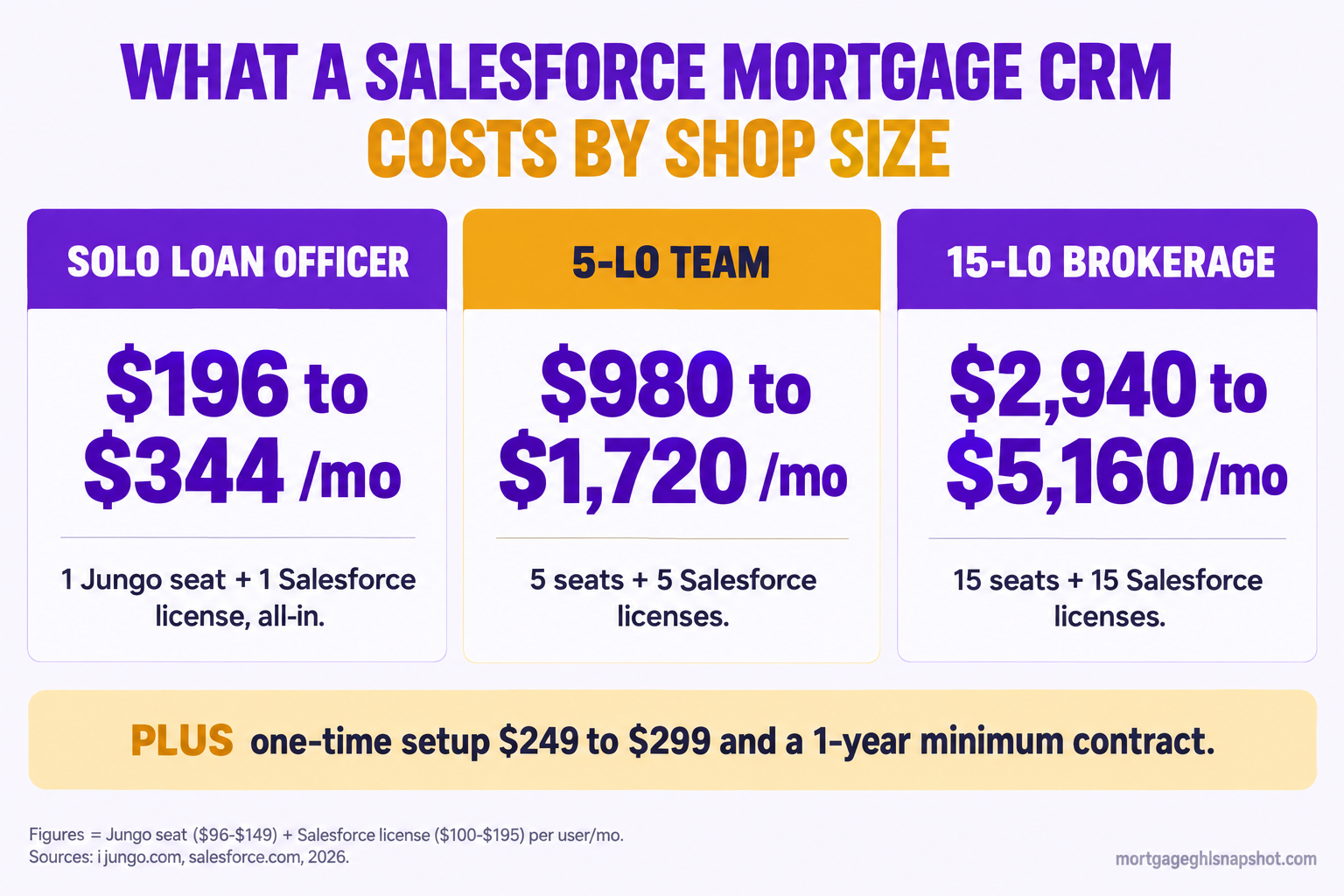
The solo loan officer. This is where Jungo is hardest to justify. One Jungo seat plus one Salesforce license is roughly $196 to $344 a month, all-in, before setup. BNTouch’s published Individual plan is about $165 plus a $125 activation, with no second bill. A solo LO rarely needs Salesforce’s enterprise muscle, and would be buying a platform sized for a 50-seat lender to solve a one-person problem.
The small team, three to five LOs. Per-user math is now the whole story, times two. At five seats you pay five Jungo licenses and five Salesforce licenses, roughly $980 to $1,720 a month before setup, against BNTouch Team at about $95 a seat ($285 to $475). The gap buys Salesforce’s depth, which pays off only if someone will build and maintain it.
The 15-LO brokerage. Here Jungo starts to make sense. Fifteen seats run about $2,940 to $5,160 a month all-in, and at this scale Salesforce’s permissions, reporting, and integrations are real value rather than overkill. The new risk is idle seats: four dead seats at two licenses each can be $784 to $1,376 a month of waste. The cheapest CRM is the one your team actually uses.
Where Jungo breaks: the failure modes
A review that only lists features is useless. Here is how Jungo actually goes wrong in a small shop, and what to do about each.
The budget blows up at renewal. The classic failure is buying on the $96 seat and meeting the Salesforce invoice at month two, with the all-in locked in for a year. The fix: model the full stack before you sign, seat, license, setup, and texting add-ons, at your real headcount. If a rep will not give you all of it in writing, that is your answer.
Salesforce complexity swallows the mortgage simplicity. The moment you want something custom, you are in Salesforce, a deep, admin-heavy platform. The failure mode is a two-person shop that buys enterprise software, cannot configure it, and uses 10% of what it pays for. If nobody is comfortable in Salesforce, budget for a consultant or pick a simpler tool.
The idle-org problem. Because you pay per seat twice, every loan officer who does not log in is double waste, and shops rarely deactivate seats when someone leaves. The fix is a quarterly seat audit: pull the login report, deactivate anyone dark for 60 days, and reclaim both licenses.
Migration in is slow, and out is slower. Getting your database into a Salesforce org is real project work, and the setup fee rarely covers a messy migration. Once your data and reporting live inside Salesforce, leaving is a project too. Ask, before you sign, what it costs to export your full database and message history, and whether your A2P 10DLC numbers move with you.
Steal this: force a real all-in number
When a vendor shows a seat price but not the platform cost, make them hand you the full number before you spend an hour on a demo.
The email that gets the all-in before the demo. Send this the moment you are tempted to book. Swap the brackets.
Subject: All-in pricing before we book a demo
Hi [name], I run a [X]-LO shop and I’m comparing mortgage CRMs this week, including Jungo and BNTouch. Before we schedule a demo, can you send me, in writing: (1) the Jungo seat price for [X] users on your best annual rate, (2) whether a Salesforce license is included or billed separately, and if separate, which edition and its cost, (3) the one-time setup fee, (4) whether texting and a dialer are included or billed as add-ons with the rates, and (5) the minimum contract. If the all-in is in range, I’ll book the same day. Thanks.
Naming the Salesforce question is the whole trick: a rep who answers it plainly is being straight with you, and one who dodges it just told you the license is separate and real.
The six questions to ask on any mortgage CRM demo. Ask all six of every vendor and record the answers side by side:
- What is the total monthly cost at my headcount today, including every platform this rides on, with nothing “starting at”?
- What is the one-time setup fee, and is it waived on an annual plan?
- Are texting and the dialer included or billed separately, at what rates, and who handles my A2P 10DLC registration?
- What is the minimum contract, and what happens to my data and sending numbers if I leave?
- Is this mortgage-ready out of the box, or a platform I configure? Show me the pre-built loan pipelines.
- What does migrating my database in actually cost, in dollars and in days?
Question one is the one Jungo’s sticker hides; question four saves you in year two. Get both in writing before you sign. For the done-for-you alternative where none of this is per seat, see our pre-qualification automation and mortgage CRM buyer’s guide.
The cost no CRM prices: compliance
Jungo does not sell you compliance, and neither does any competitor. The rules land on the originator, not the software, in the most constrained corner of the business.
RESPA Section 8 bans paying for referrals outright. A lawful marketing services agreement with a realtor must be for payments “reasonably related to the value of services actually performed,” not per-referral and not scaled to lead volume (12 CFR 1024.14(g)). The CFPB rescinded its 2015 MSA bulletin in 2020, but the statute never moved (CFPB, 2020). A CRM that automates realtor co-marketing just makes a violation faster and better documented. We walk through the safe version in our RESPA-safe realtor co-marketing guide.
The SAFE Act requires your NMLS ID on advertising, including the automated texts and emails a CRM sends (12 CFR Part 1008). TCPA and A2P 10DLC govern the texting every one of these tools wants to do. UDAAP exposure sits on any rate or APR claim your templates generate. The CRM executes compliance at scale, so configuration matters more than the logo on the login screen.
Common objections, answered
“Salesforce is the biggest CRM in the world. Isn’t that worth paying for?” For the right shop, yes. Its permissions, reporting, and integration depth are best-in-class, and a 15-LO brokerage with an admin will use them. A solo LO or three-person team pays enterprise prices for capacity they never touch. The platform is not the question; whether you will use it is.
“I already pay for a CRM I barely use. Why would Jungo be different?” It would not be, if you half-configure it the same way. Jungo is more platform, not less, so an idle Jungo costs more than an idle lightweight CRM, twice over. The quiet-CRM problem is setup and adoption, not software. We cover the recovery side in how to revive a mortgage database you never touch.
“Why isn’t GoHighLevel in the same column as Jungo?” Different shape. Jungo is a mortgage layer you rent on top of Salesforce, billed per seat, twice. GoHighLevel is a platform you build a mortgage system on once, usually for a flat fee with no per-seat tax, which is the thinking behind our own product. One scales its bill with every hire; the other does not.
Frequently asked questions
Jungo pricing and fit, answered
How much does Jungo mortgage CRM cost in 2026?
Jungo publishes seat prices of about $96 per user per month on the annual Lite plan (or $119 billed monthly) and about $125 on the annual Bundle plan ($149 monthly), with a one-time $249 to $299 setup and a one-year minimum. But Jungo is a Salesforce-native app, so most deployments also need a separate Salesforce license, billed by Salesforce at roughly $100 to $195 per user per month. All-in, budget closer to $196 to $344 per user per month.
Is the Salesforce license included in Jungo's price?
Jungo's pricing page does not itemize it or name a required edition, so you must confirm it in writing. Most mortgage Jungo deployments run in the customer's own Salesforce org on separately billed Salesforce licenses, which roughly doubles the per-seat cost. Ask the rep directly whether the license is bundled or separate, and if separate, which edition and what it costs.
Is Jungo at jungo.com?
No. The mortgage CRM Jungo is at ijungo.com. The domain jungo.com belongs to an unrelated telematics company and has nothing to do with mortgage software. Price and evaluate the product only from ijungo.com.
Jungo vs BNTouch: which is cheaper for a solo LO?
BNTouch, clearly, for a one-person shop. It publishes an Individual plan at about $165 a month plus a $125 activation, with no platform underneath. A single Jungo seat plus a Salesforce license lands around $196 to $344 all-in. Jungo only earns its price at larger team sizes where Salesforce's depth gets used.
Who is Jungo actually the right choice for?
A larger shop or brokerage that already lives in Salesforce, has someone who can administer it, and will use the platform's reporting, permissions, and integrations. A solo LO or small referral-driven team without a Salesforce admin will likely pay for power they never turn on.
So back to that almost-entered card. Jungo is a real, capable mortgage CRM, and for a Salesforce-committed brokerage it can be the right call. But you now know what the pricing page would not tell you: the seat is half the bill, the Salesforce license is the other half, and a solo LO is usually buying enterprise weight to solve a small-shop problem. Send the demo email, get the all-in number in writing, and measure it against a published anchor like BNTouch. The right CRM is the one whose true price you can see, and that your team will actually log into.