
It is 9:15pm and a borrower named Dana clicks “Apply Now” on your website. She fills in her name, her email, and the address of the house she wants. Then the form asks for her employer, two years of history, her gross monthly income, and the last four of her Social Security number. She pauses. The kids need to go to bed. She closes the tab, tells herself she will finish tomorrow, and never does. You never even knew she was there.
That borrower was ready. She clicked, she started, and then your application lost her somewhere between field four and field forty. This is the quiet leak in almost every loan officer’s pipeline: not the leads you never got, but the ones who raised their hand and slipped away because finishing was too hard and nobody followed up. This guide is the system I build to fix it: six stages, the real message copy, the timing, and the compliance lines that keep it legal.
What application abandonment actually costs you
Most loan officers obsess over the top of the funnel, then pour those hard-won leads into an application that quietly loses a quarter of them. Here is the number. Point-of-sale platforms typically carry only 60% to 75% of borrowers from application start to finish, and even the best systems top out around 80% to 85%, per a 2025 Mortgage Bankers Association editorial by BeSmartee CEO Tim Nguyen (MBA NewsLink, 2025). One in four to one in three people who start your application never finish it. They are not cold leads, they clicked apply.
Point-of-sale completion and funnel benchmarks. Source: MBA NewsLink (2025).
Now put a dollar figure on it. In Nguyen’s model, a firm with 10,000 starts a year, a 25% application-to-submission rate, a 55% submission-to-funding rate, and $9,000 of gross revenue per funded loan funds about 963 loans at 70% completion. Lift completion to 80%, and the same firm funds about 1,100: roughly 137 more funded loans and about $1.23M in extra gross revenue, with no new leads bought.
Funded loans per 10,000 application starts at each completion rate, holding a 25% application-to-submission and 55% submission-to-funding rate (75% interpolated). Source: MBA NewsLink (2025), illustrative model.
That is a lender-scale example, but it holds at any size. Run the same math on 200 starts a year and a 70% rate becomes about 19 funded loans while 80% becomes about 22: three extra closings a year from a leak you already paid to create. The reasons borrowers quit are boring and fixable, and none of them need a better lead. They need a completion system.
The six-stage completion system, start to finish
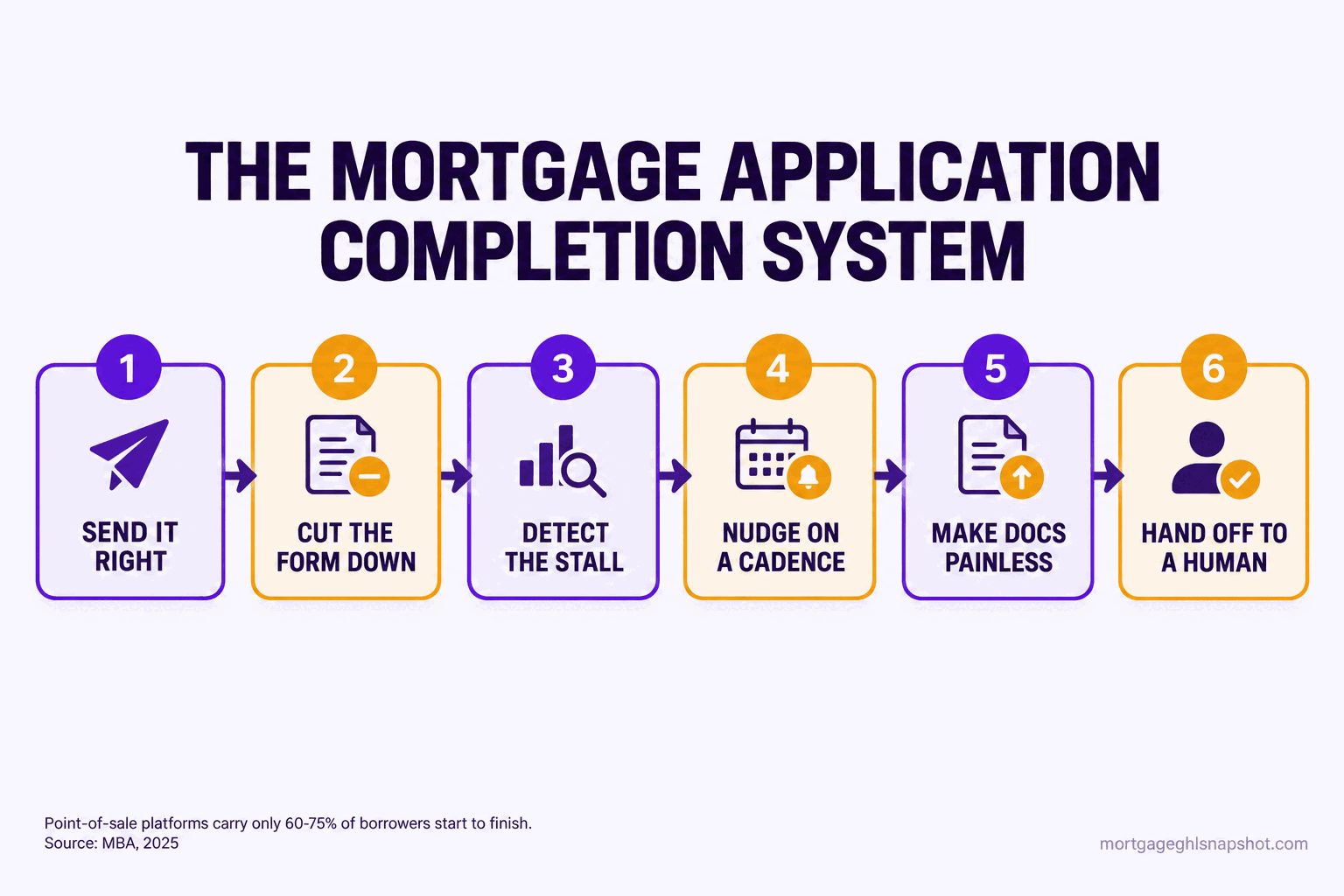
Think of the application like a checkout cart, and the fix is what e-commerce figured out a decade ago: make it short, save their progress, follow up fast. Here are the six jobs, each of which a decent CRM and workflow setup can run so they do not die the first busy week.
- Send the application the right way. One link, the right channel, works on a phone.
- Cut the form down. Ask for the minimum to start, let them save and resume.
- Detect the stall. Know the instant someone started and went quiet.
- Nudge on a cadence. A short, human sequence, logged with consent.
- Make documents painless. A clear needs list, secure upload, reminders.
- Hand off to a human. Know when automation should stop and you should call.
The stages, with setup, failure modes, and copy
Stage 1: Send the application the right way
Setup. Send it on the channel the borrower used: if they texted, text the link; if they used a web form, email and text it. One clear link to a single mobile-friendly application, no 1003 PDF and no login wall. Fire it within minutes, because speed to lead decides whether they are still paying attention.
How it breaks. A blank URLA PDF to print and scan, a link that arrives six hours late, or a form that collapses on mobile each bleed borrowers before they type a character.
Stage 2: Cut the form down
Setup. The longer the form looks, the more people bail, so do not ask for everything up front. Start with a short 1003-lite intake that collects just enough to be useful: name, contact, property, rough income, and the goal. Let the borrower save and resume, and save the heavy lifting, full employment history and asset detail, for after they are invested. Every field you remove from screen one is a borrower you keep.
How it breaks. You front-load the full application because “we need it all eventually,” and lose the people who would have finished a short one. Or there is no save-and-resume, so the 9pm quitter has to redo everything and does not.
Stage 3: Detect the stall
Setup. This is the stage almost everyone skips, and the one that makes the rest work. Your system needs to track three states: not started, started and active, and stalled. A stall is a borrower who began but has not touched the form in, say, 20 minutes, or who finished the short intake and never came back. The moment it flags a stall, it starts the nudge sequence and pings you. If you cannot see the stall, you cannot save the borrower.
How it breaks. Your application platform and your CRM do not talk, so a half-finished application sits where you never look until the borrower has applied somewhere else. Wire the start and stall events into the CRM so follow-up is automatic.
Stage 4: Nudge on a cadence
Setup. When a borrower stalls, a short, friendly, human sequence brings a real share of them back: a gentle reminder within the hour, reassurance the next morning, an offer of help on day two, and a final soft check before a longer nurture. Mix text and email, and make every message sound like a person.
How it breaks. You send nothing and the borrower forgets you exist, or you blast five identical “You haven’t finished your application!” texts in a day and read like a robot having a meltdown. Space them out and give an easy opt-out.
Stage 5: Make documents painless
Setup. The second big quit point is documents. A borrower who happily typed their info freezes when you ask for pay stubs, bank statements, and tax returns, because those are not in their pocket at 9pm. Make it easy: a plain-language needs list (“two recent pay stubs, two months of bank statements, last year’s W-2”), a secure upload link that works from a phone camera, and a short reminder cadence. Confirm each document as it lands. Progress they can see is progress they finish.
How it breaks. You send a jargon-filled conditions list, no upload link, and silence, so the borrower emails a blurry photo to the wrong address and gives up when nobody confirms it arrived. Or documents sit for a week and the loan goes cold.
Stage 6: Hand off to a human
Setup. Automation keeps the easy ones on track; your job is to catch the ones the sequence cannot. Set a rule: a high-value borrower who stalls gets a personal call fast, not another text; a borrower who replies with a real question is answered by a human; a borrower who goes fully quiet after the cadence drops into a long-horizon pre-approval follow-up. The automation is the net. You are the closer.
How it breaks. You let the robot run the whole relationship, so a confused but serious borrower gets a fifth automated text instead of the two-minute call that would have closed them, and the $600,000 purchase gets treated like a tire-kicker.
Solo LO, small team, and a high-volume shop
The six stages are the same at every size. What changes is how much runs on you and how much runs on the system.
The solo loan officer. You cannot babysit every half-finished application, so the automation is your second set of hands. Let the system send the link, detect the stall, and run the cadence, and save your own time for the handoff: the call to the borrower who is clearly serious and clearly stuck. At solo volume, even a few saved applications a year is a real piece of your income.
The small brokerage with 2 to 15 LOs. Your risk is inconsistency. One LO chases stalls like a hawk and another lets them rot, so the firm’s completion rate is a coin flip depending on who caught the lead. Standardize it: every application start triggers the same send, stall detection, and nudge sequence, no matter which LO owns it, and track completion rate per LO so you can see who is missing the system everyone else has.
The high-volume shop. At scale, completion rate is the cheapest growth you can buy, exactly as the MBA model shows. Manage it weekly: segment stalls by loan type, test the nudge copy and timing, and route your highest-value stalls to a live team within minutes. A point or two of completion is worth more than most of what your marketing budget buys.
The compliance rules that govern the application
The application is different from the rest of your marketing. The moment a borrower gives you real information, legal clocks start, and the automation has to respect them. None of this stops the system; it shapes how you build it.
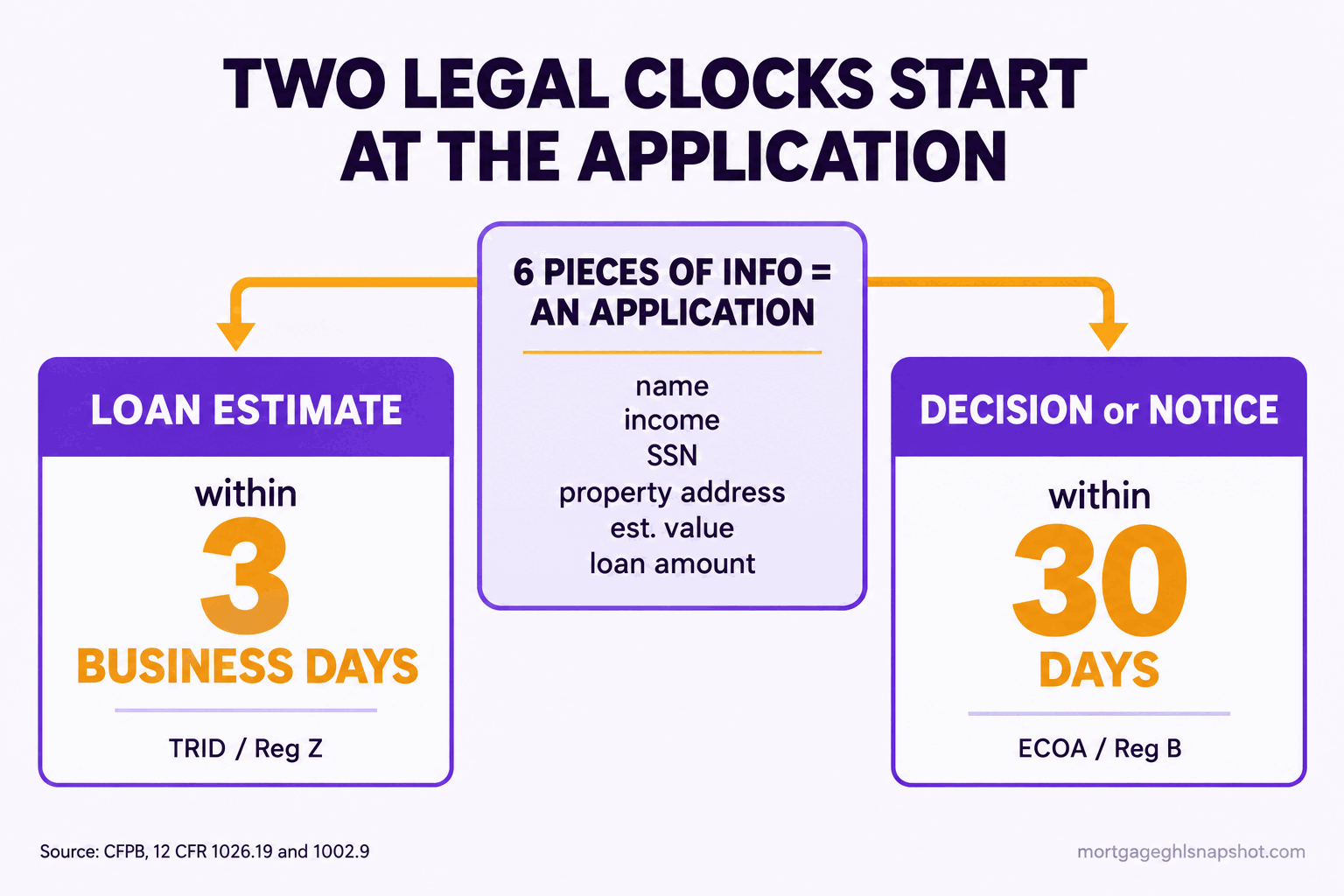
Two clocks start when the application is “complete enough.” Under TRID, a mortgage application legally exists once you have six pieces of information: the borrower’s name, income, Social Security number, property address, an estimate of value, and the loan amount sought. Once you have those six, you must deliver or mail a Loan Estimate within three business days (CFPB, Reg Z 1026.19). That is the real line between a soft pre-qualification intake and a formal application, so your system needs to know which side it is on.
Reg B gives you a 30-day window. Once an application is complete, the Equal Credit Opportunity Act and Regulation B require you to notify the applicant of your decision within 30 days (CFPB, 12 CFR 1002.9). For one that stays incomplete, you must within 30 days either act or send a formal notice of incompleteness. Friendly “please finish” nudges are fine, but they do not pause that clock, and a genuinely stalled file eventually needs a compliant notice, not a fourth text.
ESIGN consent comes before electronic delivery. If you deliver disclosures and collect signatures electronically, the ESIGN Act requires affirmative consumer consent first. Before the borrower agrees, you disclose their right to paper copies, their right to withdraw, and the hardware and software they need, and the consent must reasonably show they can access the format (15 U.S.C. 7001, via Cornell Law). Bake that step into the front of the application.
GLBA means the data you collect is protected. The instant you capture a Social Security number, income, and bank statements, you hold nonpublic personal information, and the FTC Safeguards Rule requires a real information-security program to protect it (FTC Safeguards Rule): secure upload links, access controls, and encryption, never pay stubs in an inbox or a group text.
TCPA governs the texts, and your NMLS ID goes on the application. You need consent to text a borrower’s cell, you must honor STOP immediately, and your texting should be registered through A2P 10DLC so it delivers (text message compliance guide). And because the application page and follow-up count as advertising, your NMLS ID belongs on them, with the other required disclaimers.
The objections I hear every week
“Won’t all these texts annoy people?” Only if they are robotic and relentless. A borrower who just got stuck in an application is usually relieved to hear from you. The sequence above is four spaced, human messages, each with an easy opt-out. The annoyance comes from volume and tone, not from following up at all.
“I already use a point-of-sale tool. Isn’t this handled?” A POS platform gives you the form. It rarely gives you the system around the form: instant stall detection, a cross-channel nudge cadence, handoff rules, and the connection back to the CRM. Plenty of firms with a good POS still lose a quarter of their starts, because nobody built the follow-up. The form is one stage out of six.
“My volume is too low to bother.” Low volume is exactly why it matters. When you only get a handful of starts a month, you cannot afford to lose one to a long form and silence. For you, every saved application might be a good month instead of a slow one. The system costs about the same whether you have 10 starts or 10,000, and you can wire it yourself or start from a prebuilt system that already has the pieces.
Go back to Dana, who closed the tab at 9:15pm. In a shop with this system, she gets a text within the hour that her application is saved and halfway done, a warm reminder the next morning, and an offer to hop on a two-minute call when she stalls on the income section. She finishes on day two, on her lunch break. Same borrower, same lead, same website, plus a system built to walk her across the finish line.
Why do borrowers abandon online mortgage applications?
Usually for boring, fixable reasons: the form is too long, it is clumsy on a phone, it demands documents the borrower does not have handy, or nobody follows up when they stall. Point-of-sale platforms typically carry only 60% to 75% of starters to the finish, so one in four to one in three never completes. The fix is a shorter staged form plus automated stall detection and follow-up.
What is a good mortgage application completion rate?
Per a 2025 MBA editorial, many point-of-sale platforms land at roughly 60% to 75% completion, while best-in-class systems reach 80% to 85%. Moving up even 10 points is a large revenue gain because you are converting starts you already paid for. Measure your own rate first, then work the six-stage system to close the gap.
When does a mortgage pre-qualification become a formal application?
Under TRID, you have a legal application once you hold six pieces of information: the borrower's name, income, Social Security number, property address, an estimate of property value, and the loan amount sought. At that point you must deliver a Loan Estimate within three business days under Regulation Z, and a 30-day Reg B decision clock applies. A soft pre-qualification that stops short of all six does not trigger those duties.
Is it legal to text borrowers to finish their application?
Yes, with consent. Under the TCPA you need the right consent to text a borrower's cell, honor STOP immediately, and register your business texting through A2P 10DLC so it delivers. Capture texting consent at the start of the application, log it, and include an opt-out in every message.
How fast should I follow up when someone stalls on the application?
Fast. The first nudge should fire within the hour the borrower goes quiet, while they are still near a device and thinking about the house. A good cadence is a reminder within the hour, reassurance the next morning, an offer to help on day two, and a final soft check a few days later.