It is Thursday afternoon and you are boosting a post about a rate you are proud of. The creative looks clean. Three days later a competitor screenshots it and sends it to your state regulator with one note: no NMLS ID, no APR, implied government program. Now you are explaining yourself to an examiner instead of working your pipeline.
Here is the short version. There is no single federal rule that says “put your NMLS ID here.” The requirement is a patchwork of federal advertising law, a federal loan-document rule, the SAFE Act, and state law that changes at the border. The fix is boring and permanent: build one compliant disclosure block per surface, paste it everywhere, stop improvising. This post gives you that copy, surface by surface, with the rule behind each line.
What a missing disclaimer actually costs you
A disclaimer feels like fine print nobody reads. The penalties are not fine print.
Start with text messages, where most loan officers quietly rack up exposure. Under the Telephone Consumer Protection Act, a borrower can sue for $500 per violating message, trebled to as much as $1,500 per text for a willful violation (47 U.S.C. §227(b)(3)). Each text is a separate count. Blast 300 non-consented past clients and the math is $150,000, not $500.
Then there is your license. Most states adopted the SAFE Act model language requiring your unique identifier on applications, solicitations, and advertisements (NMLS). The federal backstop caps the civil penalty at $25,000 per act or omission (12 U.S.C. §5113), and states run their own schedules on top.
The biggest numbers come from deceptive advertising. The CFPB fined reverse-mortgage lender Nationwide Equities $140,000 for mailers that violated the MAP Rule and Regulation Z (CFPB, 2021). It ordered RMK Financial to pay $250,000 in 2015 for ads implying a government tie, and when RMK repeated it, hit the firm with a $1,000,000 penalty in 2023 and a ban from the business (CFPB, 2023).
CFPB civil penalties in mortgage advertising enforcement actions. The 2023 RMK penalty was higher partly because the firm repeated conduct a 2015 order already barred. Sources: CFPB, CFPB.
Why there is no single “NMLS ID goes here” rule
Loan officers keep asking me for “the rule” as if there is one line in one regulation. There is not, and that is why people get it wrong. Four sources each own a piece.
Regulation Z §1026.24 controls what a closed-end mortgage ad may say about terms. It says a great deal about trigger terms and nothing about your license number (CFPB).
Regulation Z §1026.36(g) is the federal NMLS ID rule, but it applies to loan documents, not marketing: the company and individual originator names and NMLSR IDs on the credit application, disclosures, note, and security instrument (12 CFR §1026.36).
The SAFE Act requires you to give your unique identifier to a consumer on request, before you act as an originator, and in your initial written communication (NMLS).
State law is where “NMLS ID in advertising” actually lives. Most states adopted the model provision putting your identifier on solicitations and advertisements, and a handful add their own twists. That is why the same Facebook ad can be compliant in one state and a violation across the river.
So the honest answer to “where does my NMLS ID go” is: on your loan documents by federal rule, on your advertising by your state’s rule, built to the stricter of the two.
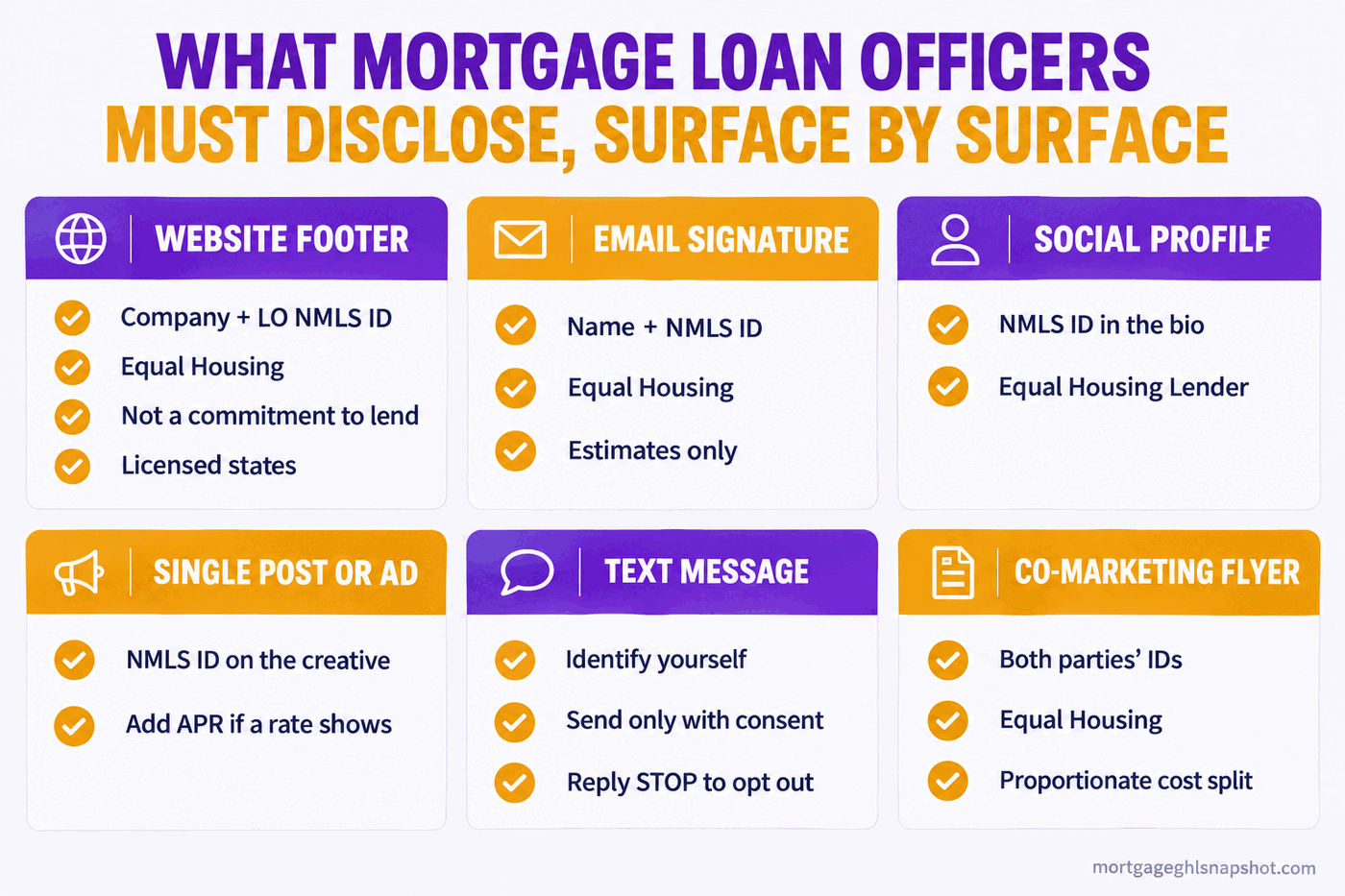
The disclaimer swipe file, surface by surface
Every surface has a slightly different job. A website footer can carry a full paragraph. A text message cannot. Below is the copy I hand new originators, with the required elements and the failure mode for each. Replace the bracketed fields and store the final versions as snippets in your CRM so nobody retypes them.
1. Your website footer
Your site has room for the full disclosure, so it carries the most: the legal entity, the company and individual NMLS IDs with a link to NMLS Consumer Access, Equal Housing, a clear “not a commitment to lend,” and your licensed states.
[Company Legal Name] | NMLS #[Company ID] | [Your Name], Loan Officer, NMLS #[Your ID]. Verify our licenses at nmlsconsumeraccess.org. Equal Housing Opportunity. [Company Legal Name] is a licensed mortgage [broker/lender], not affiliated with any government agency. This is not a commitment to lend or an offer to extend credit. All loan approvals are subject to underwriting, credit, income, and property review. Rates and terms are estimates and may change without notice. Licensed in: [list states]. Not licensed in all states.
How it breaks: a site listing “FHA, VA, and USDA loans” with a government seal and no “not affiliated with any government agency” line is the exact fact pattern that cost RMK Financial a $1,000,000 penalty (CFPB). The Equal Housing line is load-bearing too: HUD treats the logo or statement as evidence you complied with the Fair Housing Act, and for FHA-related advertising it is required (24 CFR §200.620).
2. Your email signature
Your signature is marketing, and often your “initial written communication” under the SAFE Act. Keep it tight.
[Your Name] | Loan Officer | NMLS #[Your ID] [Company Legal Name] | NMLS #[Company ID] | Equal Housing Opportunity [phone] | [email] | nmlsconsumeraccess.org This email is not a commitment to lend. Rates and terms are estimates subject to change.
How it breaks: a slick HTML signature where the NMLS line is an image. If the image fails to load, your identifier disappears. Keep the NMLS IDs as real text, not baked into a logo graphic. Texas is explicit that identifiers cannot be hidden through graphics, shading, or color (7 Tex. Admin. Code §56.203).
3. Your social media profile
Regulators treat your profile bio as the place your identifier lives for everything you post. Texas says the requirement is satisfied by displaying the information prominently on the home or profile page, so a viewer does not have to dig through old posts (7 Tex. Admin. Code §56.203(e)). Put this in the bio of every business account.
[Your Name], Loan Officer, NMLS #[Your ID] | [Company], NMLS #[Company ID] | Equal Housing Lender | Verify: nmlsconsumeraccess.org
How it breaks: a “team” page under a brand name with no company identifier anywhere. Team names and logos are for advertising only, and the company’s legal name and NMLS ID have to appear with the team name in substantially equivalent prominence (7 Tex. Admin. Code §56.203(f)). A cute handle with no license trail is a finding waiting to happen.
4. A single post or paid ad
This is where most trouble starts: a single image or video has no room for a paragraph and people leave the disclosure off. The rule: if your profile carries the full identifier, a post needs at least your NMLS ID with the creative. The moment the post states any loan term, Regulation Z wakes up.
[Your Name] | NMLS #[Your ID] | [Company] NMLS #[Company ID] | Equal Housing Opportunity. Estimates only, not a commitment to lend.
If the post mentions a down payment, the number of payments, the payment amount, or a finance charge, those are “trigger terms” under §1026.24(d)(1), and you must then also disclose the down payment, repayment terms, and APR (CFPB). That is why “3.5% down, $1,450/month” with nothing else is a Reg Z problem. For the full breakdown, read how to advertise mortgage rates without getting fined.
How it breaks: a Reel that flashes “rates from 5.99%” with no APR, no identifier, and an implied approval. That single clip can carry a Reg Z trigger-term violation, a SAFE Act identifier violation, and a UDAAP problem at once.
5. Text messages
Texts are short, which makes people sloppy, and they are the most litigated channel here. A compliant business text identifies you and your company, is sent only to someone who gave consent, and gives a working opt-out.
[Your Name] at [Company] (NMLS #[Your ID]). [Message]. Reply STOP to opt out.
How it breaks: texting a number without prior express consent, or ignoring a STOP. Both are the $500-to-$1,500-per-message exposure from the cost section (47 U.S.C. §227). Consent and opt-out are the whole ballgame, so route it through a system that logs consent and honors STOP automatically. Our SMS automation handles the opt-out, and the text-message compliance guide covers consent, 10DLC, and quiet hours.
6. A realtor co-marketing flyer
A shared flyer is two advertisers on one page, so it needs both parties’ identifiers and a cleaner compliance story than most people give it: your name, NMLS ID, and company; the agent’s name, brokerage, and license number; Equal Housing.
Brought to you by [Your Name], [Company], NMLS #[Your ID] and [Agent Name], [Brokerage], [Agent License #]. Equal Housing Opportunity. This is not a commitment to lend. Each party paid its proportionate share of this advertisement.
How it breaks: the identifiers are the easy part. The hard part is who paid. Under RESPA Section 8 you cannot pay a realtor for referrals, and any cost split has to reflect the fair value each party received, not the deal flow they send you. A flyer where you quietly cover 90% of a “joint” ad is the classic Section 8 trap. We cover the audit-proof version in RESPA-safe realtor co-marketing; the “proportionate share” line only helps if it is true.
The state rules that actually differ: California and Texas
Most of the swipe file is national. Two big states change the baseline enough that you build differently.
California. A real estate broker doing mortgage work advertises under the Department of Real Estate, which wants your eight-digit DRE license number in addition to your NMLS identifier, on everything from business cards to flyers (CA DRE, RE 858). The authority is Business and Professions Code §10140.6. A California footer carries one extra element most states never ask for: “CA DRE #[number].” Miss it and you are non-compliant even with a perfect NMLS line.
Texas. The Department of Savings and Mortgage Lending spells it out in 7 Tex. Admin. Code §56.203: an advertisement must contain the company’s name and NMLS ID, the website if it has one, and the sponsored originator’s name and NMLS ID. A company advertising directly does not have to name an individual originator, but a sponsored originator advertising on their own does. Social media is satisfied by displaying the information prominently on the profile or home page, and team names must sit next to the legal name and NMLS ID in equal prominence.
Continuing education differs too: California requires extra state-specific hours on top of the federal eight, while Texas is federal-only. The NMLS continuing-education calendar by state keeps the renewal rules straight. Here is the ad-display difference at a glance.
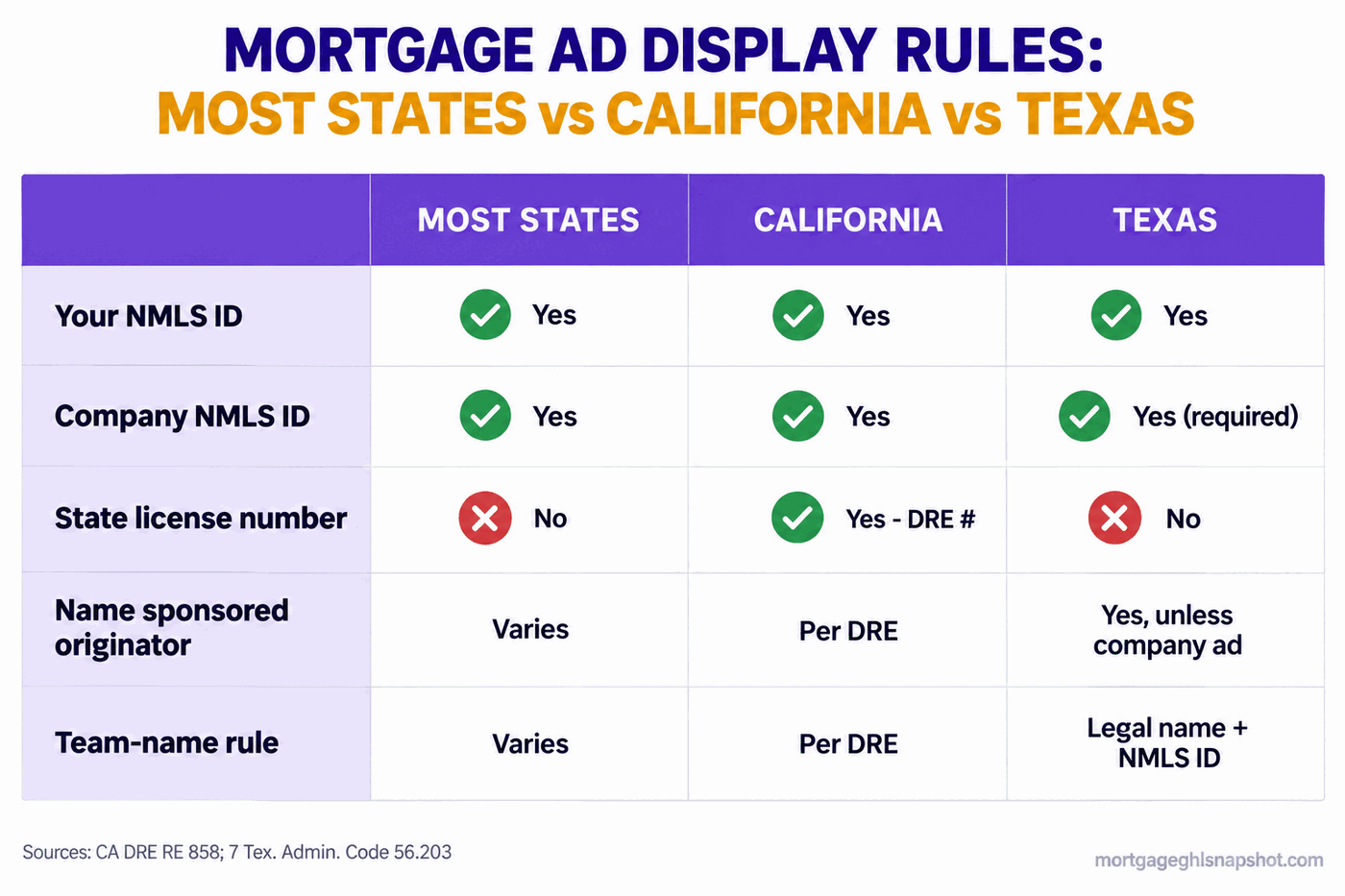
| Element | Most states | California (DRE path) | Texas |
|---|---|---|---|
| Your NMLS ID in ads | Yes | Yes | Yes |
| Company NMLS ID in ads | Yes | Yes | Yes (required) |
| State license number added | No | Yes, DRE # | No |
| Sponsored originator named | Varies | Per DRE | Yes, unless company advertises directly |
| Social media rule | Profile display | Profile display | Profile or home page, prominent |
| Team name rule | Varies | Per DRE | Legal name + NMLS ID, equal prominence |
The DRE number and the Texas sponsored-originator rule are real differences, not window dressing. If you market across state lines, build to the stricter one.
Run it solo, in a brokerage, or in co-marketing
The same rules land differently depending on how your shop is built.
You are a solo loan officer. The easy case people still get wrong by improvising. Build each block once with your real NMLS ID and your company’s, save them as snippets, never type them freehand again. Your biggest risk is a personal social account you also use for business with no identifier in the bio. Fix the bio today.
You run a small brokerage with sponsored originators. Now there are two layers of identity: the company and the individual. A company ad can run under the company NMLS ID alone in Texas, but the moment an individual LO posts their own creative, their name and NMLS ID have to appear. Keep a shared library of approved blocks, one per originator, so a new LO is not inventing a disclaimer on day three. A team brand is for advertising only and has to sit next to the legal name and NMLS ID (7 Tex. Admin. Code §56.203(f)). A prebuilt website with the footer wired per originator saves you from twelve different versions.
You co-market with realtors. Every shared piece has three jobs: both parties identified, Equal Housing present, cost split documented and honest. The identifiers are mechanical. The cost split is where RESPA Section 8 lives, and it does not care how friendly the partnership is. Keep a written record of who paid what and why, tie the payment to the fair value of the advertising and not to loan volume, and you have the paper trail an examiner wants.
The objections I hear every week
“Nobody actually gets fined for a missing NMLS ID.” On its own, maybe you get a warning. The problem is that a missing identifier rarely travels alone. It shows up next to a rate with no APR, or a text with no opt-out, and now one piece carries three violations across three regimes. The identifier is the cheapest thing on this list to get right, so there is no upside to leaving it off.
“My lender or compliance team handles all this.” They handle the company’s exposure. Your NMLS ID is on the ads and the loan documents, so your license is personally in the file. If an examiner finds a pattern of non-compliant marketing under your name, “my employer approved it” is not the shield people think.
“Disclaimers make my ads ugly and kill conversion.” This is a placement problem dressed up as a content problem. On a post, the identifier and Equal Housing line sit in the caption, not across the image. On a landing page they live in the footer. On a text they are one line at the end. Nobody bounces because you included your NMLS ID. People do bounce, and sue, over a deceptive ad.
“Instagram is just my personal account, it is not advertising.” If you post about loans, rates, or your services, regulators treat it as advertising regardless of the label. That is the point of the profile-display rule: your identifier goes in the bio precisely because individual posts are hard to disclaim (7 Tex. Admin. Code §56.203(e)). Fix the bio and the posts inherit the coverage.
Frequently asked questions
Do I legally have to put my NMLS ID on every ad?
In most states, yes. It comes from state law adopted from the SAFE Act model, which puts your unique identifier on solicitations and advertisements, not from Regulation Z §1026.24, which only governs what an ad may claim. Build the identifier into your profile and footer and it covers almost everything. See the NMLS required-use summary.
Is the Equal Housing Opportunity logo or statement required on my ads?
It depends who you are and what you advertise. For FHA-related advertising it is required under 24 CFR §200.620, and some regulators require it for lenders. Even where it is not mandatory, HUD treats the logo or slogan as evidence you complied with the Fair Housing Act, so there is no reason to leave it off.
Can I advertise a rate without triggering extra disclosures?
You can state an APR on its own, but the moment you add a down payment, a payment amount, the number of payments, or a finance charge, those are trigger terms under Regulation Z §1026.24(d)(1) and you must then disclose the down payment, repayment terms, and APR. Our guide to advertising rates has compliant examples.
What disclaimer do I need on a text message to a borrower?
Identify yourself and your company, text only someone who gave consent, and include a working opt-out such as 'Reply STOP to opt out.' TCPA damages run $500 per message and up to $1,500 for willful violations, so route texting through a system that logs consent and honors STOP. See the text-message compliance guide.
Does California really require my DRE number in addition to my NMLS ID?
Yes, if you advertise under a Department of Real Estate license. The DRE's RE 858 form requires your eight-digit DRE license number plus your NMLS identifier on all advertising, under Business and Professions Code §10140.6. See the DRE RE 858 form.
What happens if a realtor and I split the cost of a co-marketing flyer?
Splitting cost is fine if each party pays its proportionate share of the fair value received. It becomes a RESPA Section 8 problem when your share is scaled to referrals rather than advertising value. Keep a written record of who paid what and why. Our RESPA-safe co-marketing guide covers the audit-proof version.
It is Thursday afternoon again. Same post, same proud rate. This time the caption carries your name, your NMLS ID, the company ID, “Equal Housing Opportunity,” and “estimates only, not a commitment to lend,” because it is a saved snippet. The competitor can screenshot all they want. There is nothing to send the regulator.
Build the six blocks once. Paste them forever. That is the entire job.