
It is a Tuesday in late 2023 and your pipeline is a ghost town. Two years ago you could not answer the phone fast enough. Realtors were texting you listings, past clients were calling about cash-out refis, and your biggest problem was keeping files from falling through the cracks. Then rates ran from a record low to almost 8%, and the phone stopped.
Here is the part nobody says out loud. Those deals did not vanish. People still bought homes, borrowers who refinanced still refinanced, and the referrals you used to get still got made. They just got made to someone else, the loan officer who stayed in front of the borrower while you were heads-down or waiting for the market to come back. A referral pipeline does not die when rates move. It leaks, in six predictable places, and most originators never see a single one. This guide walks all six, shows where the business went, and gives you the exact messages that plug the holes.
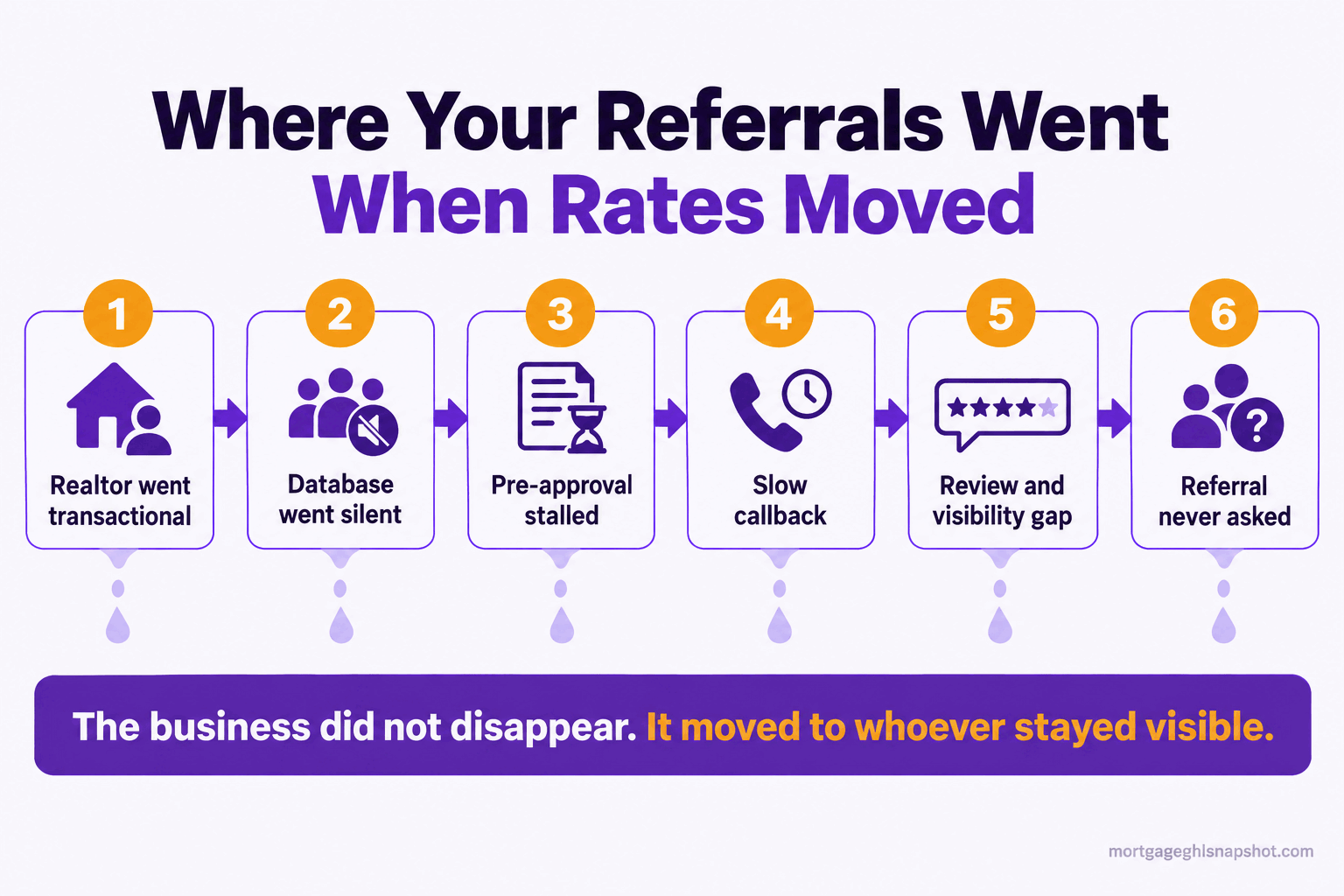
What actually happened when rates moved
Start with the size of the swing. In the first week of January 2021 the average 30-year fixed rate hit 2.65%, the lowest reading in the history of Freddie Mac’s survey, which goes back to 1971 (Freddie Mac). By the week of October 26, 2023, it averaged 7.79%, a 23-year high (Freddie Mac). A borrower on a 3% note had no reason to refinance. The refinance machine seized up: the Mortgage Bankers Association’s refinance index was down 53% year over year by mid-January 2022, and by September 2023 application volume hit its lowest level since 1996 (Mortgage News Daily).
Sources: Freddie Mac PMMS; Freddie Mac PMMS, Oct 2023; MBA weekly survey via Mortgage News Daily; ICE Mortgage Monitor, Dec 2025.
The volume dropped, but the people did not. And when rates eased in 2025, a wave of those 2021 to 2023 borrowers refinanced. Here is who got them. In Q3 2025, lender refinance retention, the share of borrowers who refinanced and stayed with their last lender, reached a 3.5-year high of 28% (ICE Mortgage Monitor). A multi-year high, and still only 28%, with banks keeping just 13%. So in the best stretch of the cycle, roughly 7 of every 10 people who refinanced did it with somebody else, usually whoever was in front of them when the rate made sense.
Share of refinancing borrowers retained by their prior lender, Q3 2025. Source: ICE Mortgage Monitor, December 2025. Even the strongest category keeps barely more than a third of its own borrowers.
That is the whole story of where your referrals went. Not to a better product or a lower rate, but to the originator who stayed in contact. Lending is a referral and repeat business: 88% of buyers used an agent, 91% of sellers used an agent, and 91% of buyers said they would use their agent again or recommend them (NAR 2025 Profile). That loyalty runs through your past clients and partners too. It is yours to lose, and when you go quiet, you lose it.
The six places your referrals leaked out
A referral pipeline does not break in one spot. It leaks in six, and each one has the same root cause: a relationship that needed a touch and got silence instead.
Leak 1: The realtor who went transactional
When volume dried up, agents started steering buyers to whoever answered first, and you stopped nurturing the relationship because you were busy surviving. The partnership quietly became transactional, and transactional partners shop you against anyone.
Why it leaks: a realtor relationship is a relationship, not a contract. Stop adding value between deals and you become one of three lenders in their phone instead of the one.
What a working pipeline does: it keeps you useful to the agent when no deal is live, with fast pre-approval turnarounds, co-branded content they can forward, and instant status updates so they never chase you. If your partners went quiet, why realtors stopped sending you deals walks the repair, and realtor referral partnerships for loan officers shows how to build partners who do not shop you.
Leak 2: The past-client database that went silent
You closed hundreds of borrowers in the boom. Every one was a future refinance, a move-up purchase, and a referral source. Then you never called them again. When rates eased in 2025 and their loan made sense to refinance, the lender who sent a rate alert got the deal, and that lender was usually not you.
Why it leaks: nothing on your calendar fires at “it has been a year since this person closed,” so the annual touch never happens, and a database with no contact is a spreadsheet of people who have forgotten you.
What a working pipeline does: it works the database with annual loan reviews, equity updates, and rate-watch triggers that reach out on their own. The full cost of skipping this is in the real cost of a mortgage database you never touch, and the recovery steps live in mortgage database reactivation.
Leak 3: The pre-approval that stalled and never came back
A buyer got pre-approved, the rate moved or the house sold, and they went quiet. You marked the file dead. But that borrower still wants a home. Six or twelve months later, when they are ready again, they start over with whoever is in front of them, because you never followed up.
Why it leaks: a stalled pre-approval looks like a dead lead, so it gets no follow-up, when it is really a warm borrower on a delay. The gap between “not now” and “ready” is where the handoff to a competitor happens.
What a working pipeline does: it keeps stalled pre-approvals in a long-term nurture track, with check-ins timed to their situation and a rate-watch alert for when their numbers change. Our piece on why pre-approvals go quiet and never close shows the cadence that brings them back.
Leak 4: The slow callback
When you were drowning in volume, speed-to-lead slipped, and a new inquiry sat for an hour, or a day, while you worked live files. In a slow market that is fatal: fewer leads, and every one is contacting three lenders. The first human to respond usually wins, and if that was not you, the referral your marketing or your partner generated just funded a competitor.
Why it leaks: manual follow-up fails exactly when you are busiest, and a lead that waits has already called someone else by the time you dial.
What a working pipeline does: it answers instantly, with an automated text-back and an intake that qualifies before you pick up. Speed is the cheapest edge in lending and the easiest to lose, which is why we wrote the full guide to mortgage speed-to-lead.
Leak 5: The review and visibility gap
This is the quiet one. When a past client’s coworker asked “who did your loan,” your borrower either remembered your name or Googled “loan officer near me.” If your Google profile was thin, your reviews were old, and your name had not crossed their feed in a year, the referral they meant to send you went to the originator with 200 reviews and a face they recognized.
Why it leaks: someone means to recommend you, cannot find you quickly, and the moment passes.
What a working pipeline does: it asks every happy borrower for a review right after closing, the moment of highest trust, and keeps you lightly present so your name is familiar when someone goes looking. A deep bench of recent reviews turns a half-remembered recommendation into a booked call.
Leak 6: The referral you never asked for
The biggest leak is the simplest. Most originators never actually ask. You assume a happy client will refer you, and sometimes they do, but a specific, well-timed ask converts far better than hope. In the boom you did not need to ask. When the market tightened, the originators with a real referral habit kept eating and the ones who relied on inbound went hungry.
Why it leaks: an unasked referral is a maybe, and maybes do not close.
What a working pipeline does: it builds the ask into the process, a genuine request at closing and a no-pressure value touch a few times a year that ends with an invitation.
Steal this: the messages that bring referrals back
You need a short set of honest messages on a schedule. Make the voice sound like you, sign with your name, include your NMLS ID where required, and give a clear opt-out on any automated text. These are templates to adapt, not legal or rate advice.
Four messages cover the whole leak map. Set them on a schedule and off real triggers, closing dates, rate movement, and time since last contact, and most of this sends itself, so no relationship that once sent you business goes quiet for long.
Solo LO, small team, and a high-volume shop
The leaks are the same at every size. How you plug them changes with your volume and your team.
The solo loan officer. You feel every leak personally because you are the whole pipeline. Start with the two touches that pay off fastest: the instant lead callback so you never lose a fresh inquiry, and the rate-watch alert against past clients so you catch the refinances you used to miss. Keep the realtor and referral touches personal, because at your size a message that clearly came from a human beats any template.
The small team (3 to 15 LOs). Your problem is ownership and consistency. A borrower closed by an LO who left last year is a borrower nobody is watching. Standardize the touches as one shared workflow so every past client and partner gets the same baseline, and keep records in one place so a departing LO does not walk out with the relationships. The build-versus-hire math gets real here, which we broke down in an in-house assistant versus a GoHighLevel setup.
The high-volume shop. At scale, nothing can depend on anyone remembering anything. Every touch fires off data: loan type, closing date, current rate, time since last contact. Segmentation is automatic, so an FHA borrower from 2022 and a jumbo borrower from 2021 get different, relevant outreach without a human sorting the list.
The RESPA and TCPA lines you cannot cross
Plugging these leaks puts you in contact with realtors and borrowers, which means two bodies of law are in play, and getting them wrong turns a recovered referral into a regulatory problem. This is not legal advice, it is the short list of what to keep straight.
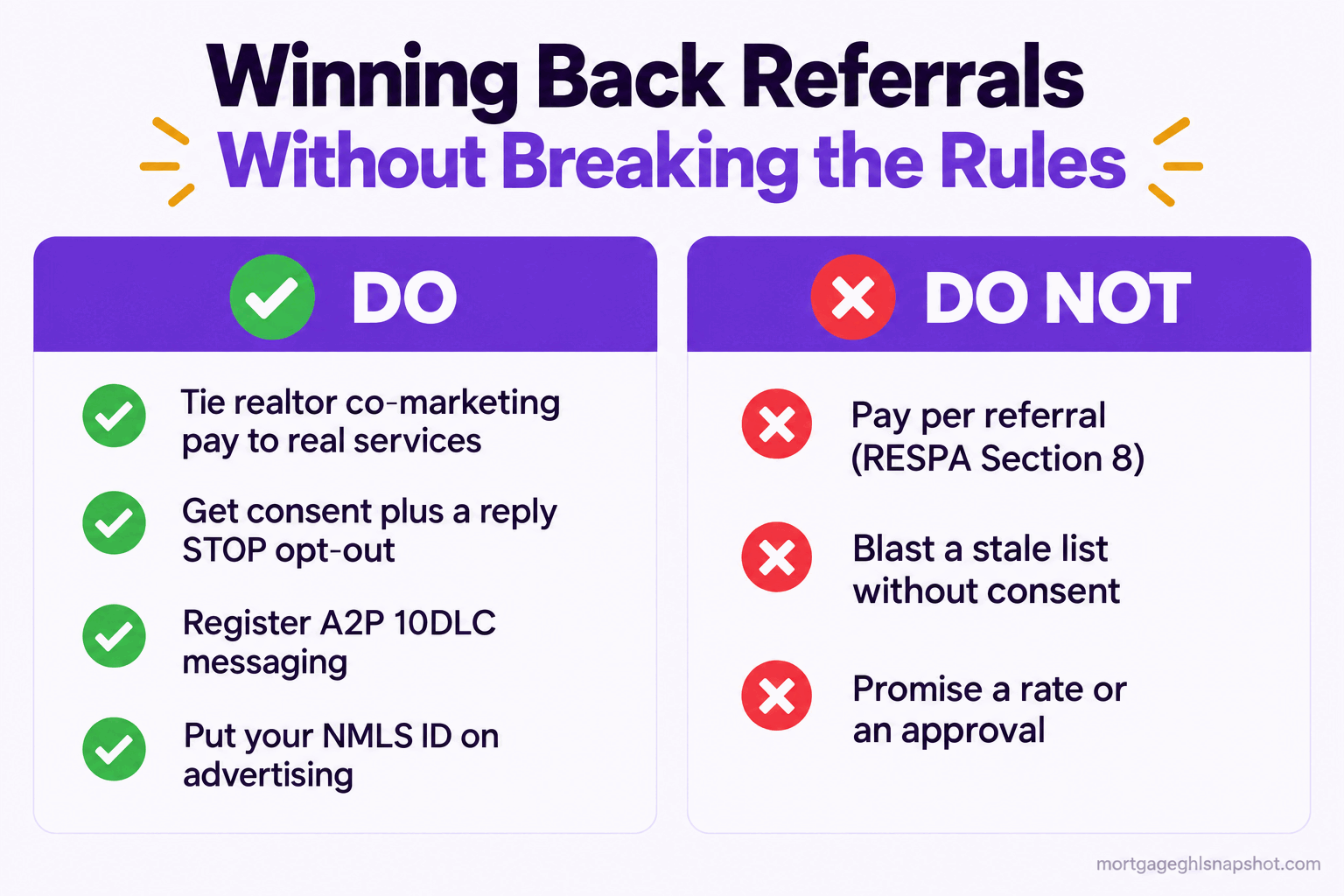
The practical move is simple. Before you run any rate or refi messaging at a dormant contact, send the opt-in or check-in message first. It re-establishes a clear yes and turns a legally murky blast into a permission-based conversation. On the realtor side, keep every co-marketing dollar tied to real, documented services, never to the number of deals an agent sends.
The objections I hear every week
“If the market took my deals, how is a follow-up system going to bring them back?” The market did not take your deals, it moved them to the originator who stayed in contact. A follow-up system does not create demand, it makes sure that when a past client is ready to refinance, you are the name in front of them.
“My realtor partners already have a lender they trust. Why bother?” Trust decays the moment you go quiet, and the agent who trusts you today sends the next buyer to whoever was useful most recently. A monthly value touch and same-day pre-approvals keep you in the top slot.
“I already pay for a CRM. Isn’t this what it does?” A CRM you do not touch is a nicer-looking version of the spreadsheet you also do not touch. The value is the triggers that reach out on their own: the rate-watch alert, the annual review, the instant lead callback. Most originators never set those up, which is exactly why the business leaks.
“Won’t past clients find the automated texts annoying?” Only if the texts are empty. A real annual review or a genuine heads-up that their rate is worth a look reads as service, and the opt-out rate stays near zero. The ones that annoy people are the “just checking in” texts with nothing behind them.
Frequently asked questions
Where do mortgage referrals actually go when rates rise?
To the loan officer who stays in front of the borrower. Deals get scarcer and more competitive when rates rise, so the originator who responds fastest and stays in regular contact wins the smaller pool. Even at a 3.5-year high in Q3 2025, lenders kept just 28% of their own refinancing borrowers.
Why did my realtor partners stop sending me deals when the market slowed?
The relationship went transactional and you likely stopped adding value between deals. In a slow market, agents steer buyers to the lender who answers first, so if you went quiet or slow on pre-approvals, the next referral went to a more responsive competitor.
How do I win back past clients who refinanced with someone else?
Start contacting the rest of your database before they do the same thing. Most past clients have not refinanced yet, and they go to whoever reaches them when their rate makes sense. Set up an annual review, a rate-watch alert, and value touches, and lead any outreach to a dormant contact with a consent-based opt-in.
Is it legal to pay a realtor for referrals?
No. RESPA Section 8 bans giving or receiving anything of value for the referral of settlement service business. You can enter a marketing services agreement, but the payment must be reasonably related to the value of actual services performed, not tied to the number of referrals. The statute stands even though the CFPB rescinded its 2015 MSA guidance in 2020.
What is the single highest-return leak to fix first?
For most originators it is the past-client rate-watch alert combined with instant lead callback. The alert catches refinances from borrowers you already closed, the cheapest deals you will ever get, and the callback stops you losing fresh inquiries. Both run automatically once set up.
It is a Tuesday a year from now and your pipeline is not a ghost town. The realtor you rebuilt sent two buyers this month. The past client you closed in 2022 got your annual review and refinanced with you when rates dipped. The stalled pre-approval came back and closed. None of it happened because the market handed it to you. It happened because you stopped letting your relationships go quiet. The business never disappeared. It just went where the attention was, and this time that was you.